
Anyone buying business property determines three things by allocating it: the tax rate on ongoing income, the liability position and the taxation on a later sale. The most obvious route — buying privately and letting to your own GmbH — as a rule leads into a split-business structure and thereby costs the greatest advantage of private assets.
What it is about
There are three routes to choose from: first, the property is owned by the GmbH itself; second, it remains in your private assets and is let to the GmbH; or third, it is held in a separate property company alongside the operating business. The allocation is not a formality. It determines the tax rate applied to ongoing income, which assets are liable for the operating risk and what applies for tax purposes on the sale of the property or of the business.
What the allocation does
The following example underlies this entire article: a hall costing €1 million, annual rent of €60,000, after 15 years the hall is worth €1.5 million.
During ongoing operations, the rate differential is decisive. If the hall belongs to the operating GmbH, there is no rent; depreciation and costs reduce the GmbH’s profit, which bears tax of around 30 % — falling from 2028. If you let privately to the GmbH, the GmbH deducts the rent with an effect of around 30 %, while you pay tax on the same rent at your personal tax rate of up to around 47.5 %. In simplified terms, this differential costs around €10,000 a year in the example at the top tax rate; with a personal tax rate below 30 %, the effect can be reversed.
The third route lies in between: if a separate property company lets to the operating GmbH, the rent deduction at the operating GmbH is preserved, and the taxation of the rent depends on the legal form of the property company. For a property GmbH, it is around 16 % at company level if the requirements of the trade tax reduction for property are met; for a GmbH & Co. KG with a commercial character, your personal tax rate applies again. The rate differential can thus be shaped through the structure.
The allocation also affects liability: in the GmbH, the hall is within reach of the creditors of the operating business. Outside it — privately or in a separate company — it is as a rule kept apart from them.
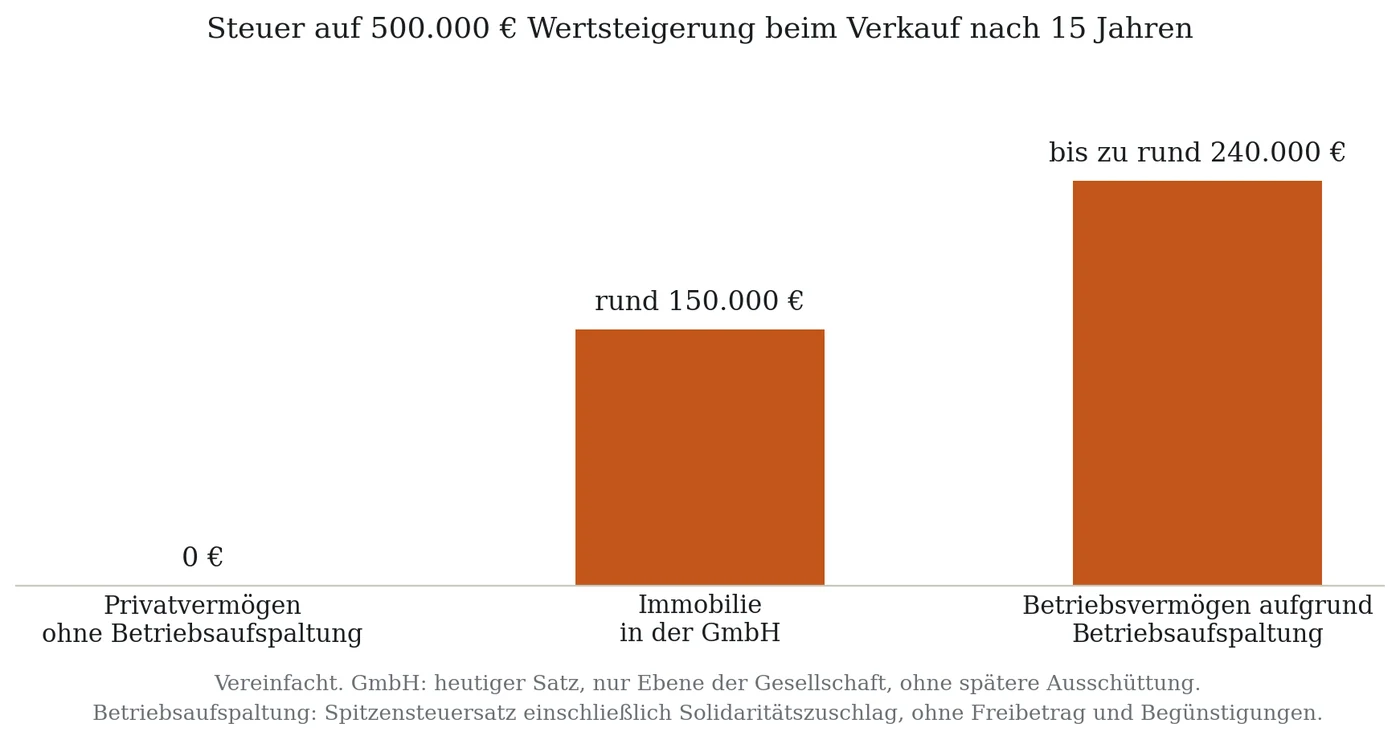
The central difference lies in the sale: in private assets, the increase in value of a let property is tax-free after ten years — but only as long as the property really is a private asset. Letting to your own GmbH as a rule leads into a split-business structure: the hall becomes a business asset, and the ten-year period no longer helps. The increase in value remains permanently subject to tax and is taxed at your personal tax rate on sale or when the structure ends. In the GmbH, the increase in value is also taxable, at around 30 % at company level.
The limits and pitfalls
- The split-business structure: When letting to your own GmbH, it as a rule arises automatically and deprives private assets of their most important advantage. Anyone who still wants to take this route should consciously protect the structure against the forced realisation of hidden reserves, for example through a GmbH & Co. KG with a commercial character.
- The rent: It must be at arm’s length. Excessive rent paid to the shareholder of the operating GmbH is a hidden profit distribution with consequences at the level of both shareholder and company.
- The one-way street: Once the property is a business asset, it cannot come back out tax-free if its value has risen. Leaving business assets realises the hidden reserves. The allocation should therefore be decided before the purchase, not years later.
What decides the choice
- Your tax rate: The higher your personal rate, the more expensive private letting is during ongoing operations — and the gap to the GmbH grows with every step of the corporation tax cut from 2028.
- The sale perspective: If the business is later to be sold without the property, there is much to be said for separating it from the operating business. This gives the buyer the choice of whether to acquire the property as well.
- Liability: In the GmbH, the property is liable for the operating business. Outside it, it is as a rule beyond the reach of creditors.
- Succession: A separately held property can be transferred or retained independently of the business. For gift and inheritance tax, it must be checked whether the let property, as so-called administrative assets (Verwaltungsvermögen), reduces the reliefs for business assets. Here, a split-business structure can have a positive effect.
In our advisory work, the weighing-up often comes down to a separate property company: as a GmbH & Co. KG with a commercial character and a controlled structure, or as a property GmbH alongside the operating business, often under a common roof with the holding. Which variant works depends on trade tax, financing and your further plans, and must be reviewed on a case-by-case basis.
Legal Form and Holding Check
We review where your business property belongs — in tax terms, in terms of liability and with a view to sale and succession — and whether your existing allocation carries a risk, such as an unrecognised split-business structure.
You receive a robust basis for decision-making with a concrete recommendation and a roadmap for implementation. We offer you a fixed price agreed before work begins. Because law and tax are under one roof with us, one team reviews both sides.
Fixed price, agreed before work begins.
Frequently asked questions
This route as a rule leads into a split-business structure: the property becomes a business asset, the tax exemption after ten years no longer applies, and the end of the structure can realise hidden reserves. It should only be chosen deliberately and with safeguards.
Only for genuine private assets. As soon as the property is a business asset — including through a split-business structure — the increase in value remains permanently subject to tax.
An arm’s-length rent: the rent the GmbH would also pay to a third party. The tax office treats excessive rent as a hidden profit distribution; rent that is significantly too low gives away business expenses of the GmbH.
This article provides a general overview for information purposes only and does not replace advice on individual cases. As of: November 2026.