
From 2028, German corporation tax will fall in five annual steps from 15 % to 10 %. Every GmbH benefits, regardless of whether it retains its profits or distributes them. How large the advantage turns out to be, and what it means for choosing a legal form, depends on what happens to the profits.
What has been enacted
The legislature passed the cut in summer 2025. From 1 January 2028, the corporation tax rate falls by one percentage point each year until it reaches 10 % in 2032. Trade tax remains unchanged. The solidarity surcharge continues to be levied at 5.5 %, but on the then lower corporation tax — so in euro terms it falls as well. For taxes on profits retained in the company, this results in the following path:
| Year | Corporation tax | Total tax on retained profits |
|---|---|---|
| until 2027 | 15 % | around 30 % |
| 2028 | 14 % | around 29 % |
| 2029 | 13 % | around 28 % |
| 2030 | 12 % | around 27 % |
| 2031 | 11 % | around 26 % |
| from 2032 | 10 % | around 25 % |
Sum of corporation tax, solidarity surcharge (5.5 % on corporation tax) and trade tax at a municipal multiplier (Hebesatz) of 400 %. All percentages in this article refer to profit before tax.
What the cut brings
It is clearest with an example that underlies this entire article: a GmbH with €100,000 profit before tax and a trade tax multiplier of 400 %.
If the profit is retained in the company, the GmbH keeps around €70,000 today. From 2032, it will be just over €75,000. Each year of the reduction adds around €1,000 that is available for investment or reserves.
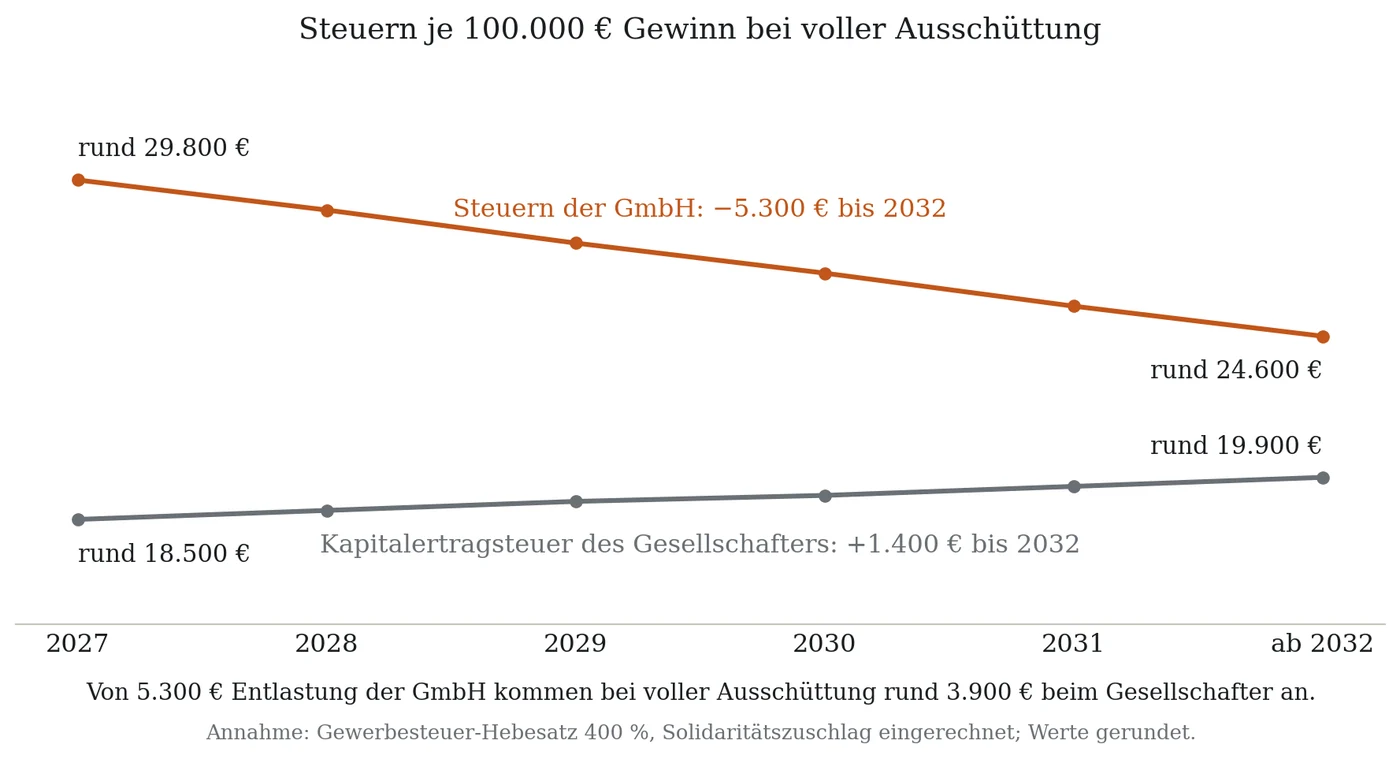
There is also an advantage with full distribution. Withholding tax on investment income continues to apply to the amount distributed at an unchanged rate, and because more can be distributed in future, it even rises in euro terms. Part of the relief at company level is thus absorbed again. On balance, however, instead of just under €52,000 today, just over €55,000 will reach you privately in future. In figures: of around €5,300 relief per €100,000 of profit, around €3,900 reaches you with full distribution; around €1,400 goes into the higher withholding tax.
The comparison with partnerships
Sole proprietorships and partnerships do not pay corporation tax. Their profits are taxed directly at the level of the owner or partner at their personal income tax rate — at the top rate, around 47.5 % including solidarity surcharge. Up to a multiplier of 400 %, trade tax is as a rule fully credited against income tax. Of the €100,000 profit in the example, around €52,500 thus remains at the top tax rate. The new law does not change this.
There is a special feature for profits that remain in the sole proprietorship or partnership: sole proprietors and partners can already apply for a reduced tax rate today to bring their taxation closer to that of a corporation — the so-called retention relief (Thesaurierungsbegünstigung). The reform brings a consequential change: this reduced rate falls in parallel with corporation tax from 28.25 % to 25 %, so that the choice of legal form remains at least roughly neutral in terms of tax burden. If the profit is later withdrawn after all, an additional subsequent tax applies. The low burden is therefore a deferral, not a final saving.
Put simply, this means for the comparison: for profits that are permanently invested in the business, the GmbH is already ahead today, and its lead grows year by year until 2032. For profits that are regularly used privately, the legal forms will remain close to each other in future too. Over the course of the reduction, the small lead shifts from the partnership to the GmbH.
What decides the choice
- How much stays in the business: The larger the share of profits permanently invested in the business, the more strongly the cut works in favour of the GmbH and of a corporate holding structure.
- Your existing structure: Changing legal form incurs notary and advisory costs. Depending on the arrangement, tax lock-up periods may also arise, for example on a contribution of a business. The tax cut alone rarely justifies the change.
- Your municipality’s multiplier: The GmbH’s taxes consist of corporation tax and trade tax. Only the first part is being reduced. The second, trade tax, depends on the location. For context: the total relief until 2032 is just over five percentage points. A trade tax multiplier 150 points lower makes the same difference — typical, for example, between a large city and its surrounding area.
For your planning, this means: if a key decision is due anyway — an incorporation, setting up a holding, a succession — the future tax rates belong in the comparative calculation. How a holding works and when it pays off is described in a separate article.
Legal Form and Holding Check
Whether GmbH, GmbH & Co. KG or holding structure: we review liability and tax burden for your specific situation, including the question of what the falling corporation tax means for your structure.
You receive a robust basis for decision-making with a concrete recommendation and a comparative calculation of your options over the coming years. We offer you a fixed price agreed before work begins. Because law and tax are under one roof with us, one team reviews both sides.
Fixed price, agreed before work begins.
Frequently asked questions
No. Trade tax remains unchanged and, at least after the reduction of the corporation tax rate, is the larger part of the tax burden for many companies. Its multiplier is set by the municipality.
They continue to pay income tax at the personal tax rate. For profits retained in the business, they can apply for the reduced rate under the retention relief; it falls in parallel to 25 %. On a later withdrawal, the subsequent tax also applies.
Not for that reason alone. What matters is the share of profits that stays in the business, the cost of the change and possible tax lock-up periods. Where structural decisions are due anyway, however, the future tax rates should be factored in.
This article provides a general overview for information purposes only and does not replace advice on individual cases. As of: November 2026.