
The split-business structure (Betriebsaufspaltung) is not set out in any statute, and yet it arises — in many cases unnoticed — as soon as you let land or a building to your own GmbH. During ongoing operations, it is often manageable. The danger lies at its end: hidden reserves are realised without any money flowing.
How a split-business structure arises
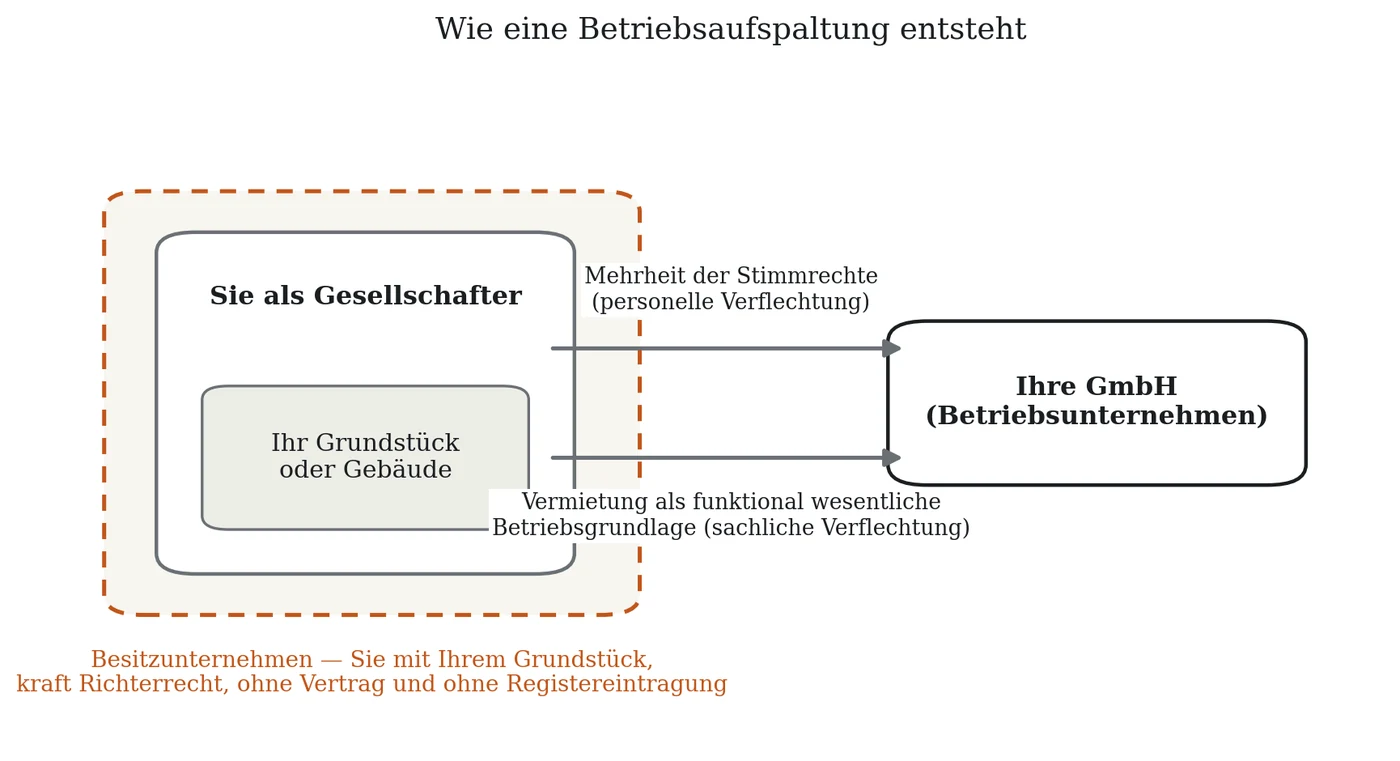
Two requirements are enough. First: you let your GmbH use a functionally essential business asset, typically the business premises on which the GmbH operates (so-called material interlinking). Second: you control both sides, as a rule through a majority of the voting rights — alone or as a group of persons with aligned interests (so-called personal interlinking).
If both requirements are met, your private letting becomes a commercial business and you as landlord become the so-called holding business (Besitzunternehmen). The property and the GmbH shares become business assets for tax purposes. For tax purposes, this happens without any contract or registration. The split-business structure is based on case law and established administrative practice, and many of those affected do not know for years that they have one.
What happens during ongoing operations
Your rental income is commercial income and subject to trade tax. Depending on the constellation, it is credited against income tax. A real additional burden arises in municipalities with a high trade tax that cannot be fully credited. The so-called extended property reduction (erweiterte Grundstückskürzung), which relieves pure landlords from trade tax, is not available. Distributions from the GmbH fall into business assets and are taxed under the partial income method. There are differences in taxation, but in most cases the consequences are manageable. The real risk lies at the end of the structure.
The typical triggers
As already indicated, a split-business structure is rarely ended by a conscious decision. More common are events that look like something else entirely:
- Succession on one side: The GmbH shares are gifted to the children, the property stays with the parents. The personal interlinking breaks, and a cessation of business is triggered.
- Sale of the GmbH: The share deal ends the split-business structure. The hidden reserves of the retained property are taxed as well, even though only the shares were sold.
- Inheritance: Fragmented shareholdings in the GmbH or heirs who are minors can cause control to lapse.
- Changes to the lease: If the GmbH moves or the lease ends, the material interlinking lapses.
- Changes to voting rights: New provisions in the articles of association can remove the majority on one side.
Two things have changed since 2024. First, in a civil-law partnership (GbR) without a separate contractual provision, voting rights are no longer allocated per capita but according to the shareholdings. This means that existing letting partnerships may have unintentionally grown into a split-business structure or fallen out of one. Second, from the 2024 assessment period onwards, the tax authorities apply stricter case law according to which indirect control via an intermediate corporation can also establish personal interlinking (Federal Fiscal Court, BFH, judgment of 16 September 2021, IV R 7/18). Structures that were considered safe before 2024 should therefore be reviewed again.
What the end costs
If either of the two forms of interlinking lapses, the split-business structure ends. For tax purposes, this is a cessation of the holding business: all hidden reserves are realised and taxed — those of the property and those of the GmbH shares, which are affected as business assets. Nothing necessarily has to be sold, and not a single euro has to flow.
Many of the triggers mentioned, however, involve a sale anyway, of the property or of the shares. The real risk of the split-business structure is then the respective other part: if only the GmbH shares are sold, the hidden reserves of the retained property are taxed too. If the structure ends through the sale of the property, the shares are hit as well, although nobody sold them.
An example: a hall built 25 years ago for €800,000 is still on the books at €300,000 after depreciation; its market value is €1.5 million. The GmbH shares with a share capital of €25,000 are worth €2 million. If the split-business structure ends, around €3.2 million of hidden reserves must be taxed. Depending on the constellation, this means well over €1 million in tax on a gain that exists only on paper. The tax-free allowance and the reduced tax rate can ease the burden; they do not change the basic problem — tax without liquidity.
How the structure can be secured
Anyone who knows about the split-business structure can shape it instead of putting up with it. The most common tool is a GmbH & Co. KG with a commercial character (gewerblich geprägt) as the holding company for the property: if the interlinking lapses later, the assets remain tax-bound and the forced realisation of hidden reserves does not occur. Alternatively, the property can be contributed to the GmbH, or the structure can be set up without interlinking from the outset. Which solution fits belongs in the same review as the question of legal form and holding. Timing is decisive: in structures prone to a split-business structure, every change in shares, voting rights or property should be reviewed for its consequences for the interlinking beforehand, not afterwards.
Five questions for today
- Do you or one of your companies let land or another essential business asset to the operating GmbH — and do you also hold the majority in that GmbH?
- Does a holding business already appear as a commercial business in your tax returns — or might the structure exist unrecognised?
- Are transfers of your GmbH coming up — gift, sale, succession — and has it been checked what they mean for the interlinking?
- Would a sale of the GmbH also affect the property for tax purposes — and is this reflected in the purchase price and liquidity planning?
- Is the structure protected against an unintended end, for example through a GmbH & Co. KG with a commercial character as the property-holding company?
If you hesitate on more than one question, we recommend a review of your structure.
Legal Form and Holding Check
We check whether a split-business structure exists in your set-up, how it is secured and what upcoming transfers would trigger — together with the liability and tax burden of your overall structure.
You receive a robust basis for decision-making with a concrete recommendation and, where necessary, a roadmap for securing the structure. We offer you a fixed price agreed before work begins. Because law and tax are under one roof with us, one team reviews both sides.
Fixed price, agreed before work begins.
Frequently asked questions
A construct developed by the courts and recognised in principle: anyone who lets their own company use an essential business asset and controls both sides runs a commercial holding business through the letting. The property and the shares in the company become business assets.
Check two questions: do you let your GmbH use land or other essential business assets? And do you control both sides, alone or with a group of persons? If both answers are yes, there is a strong indication of a split-business structure.
For tax purposes, the end counts as a cessation of business. The hidden reserves of the property and the shares are realised and taxed, possibly even without any money flowing. Forward-looking structuring, for example a GmbH & Co. KG with a commercial character, can avoid this.
This article provides a general overview for information purposes only and does not replace advice on individual cases. As of: November 2026.