
A search by the tax investigation service (Steuerfahndung) comes without warning, often early in the morning, and it also hits businesses that are not aware of any offence. What happens in the first hour can hardly be corrected later: statements and documents handed over in this phase shape both the criminal proceedings and the tax assessment proceedings.
Why the tax investigation service is different
The tax investigation service has a dual function. It investigates tax offences and at the same time determines the basis of taxation for the years concerned (Section 208 (1) of the German Fiscal Code, AO). In criminal proceedings, it has the powers of the police under the Code of Criminal Procedure (Section 404 AO). In tax proceedings, it has the investigative powers of the Fiscal Code. The same officer can act as a criminal investigator and as a tax official in the same hour. Different rules apply to the two roles.
In criminal proceedings, nobody has to incriminate themselves. As a suspect, you may remain silent. In tax proceedings, by contrast, the taxpayer’s duties to cooperate continue. However, they may not be enforced by coercive means if you would thereby incriminate yourself of a tax offence (Section 393 (1) AO). Keep the two roles apart: what you explain in a conversation about tax questions can be used against you in criminal proceedings.
A search requires an initial suspicion, i.e. factual indications of a tax offence, and is as a rule ordered by a judge (Sections 102 and 105 of the German Code of Criminal Procedure, StPO). Only if waiting for the judicial decision would jeopardise the purpose of the search (so-called imminent danger) may the public prosecutor or the tax investigation service order it themselves. The warrant specifies against whom the suspicion is directed, which premises may be searched and which evidence may be sought. It loses its effect after six months at the latest. The officers may not specifically search for items outside this scope. What they come across by chance, however, they may provisionally secure as a so-called chance find (Section 108 StPO).
The first hour: five steps
The following steps apply in the typical case. They do not replace coordination with the lawyer on site, but buy time until the lawyer arrives.
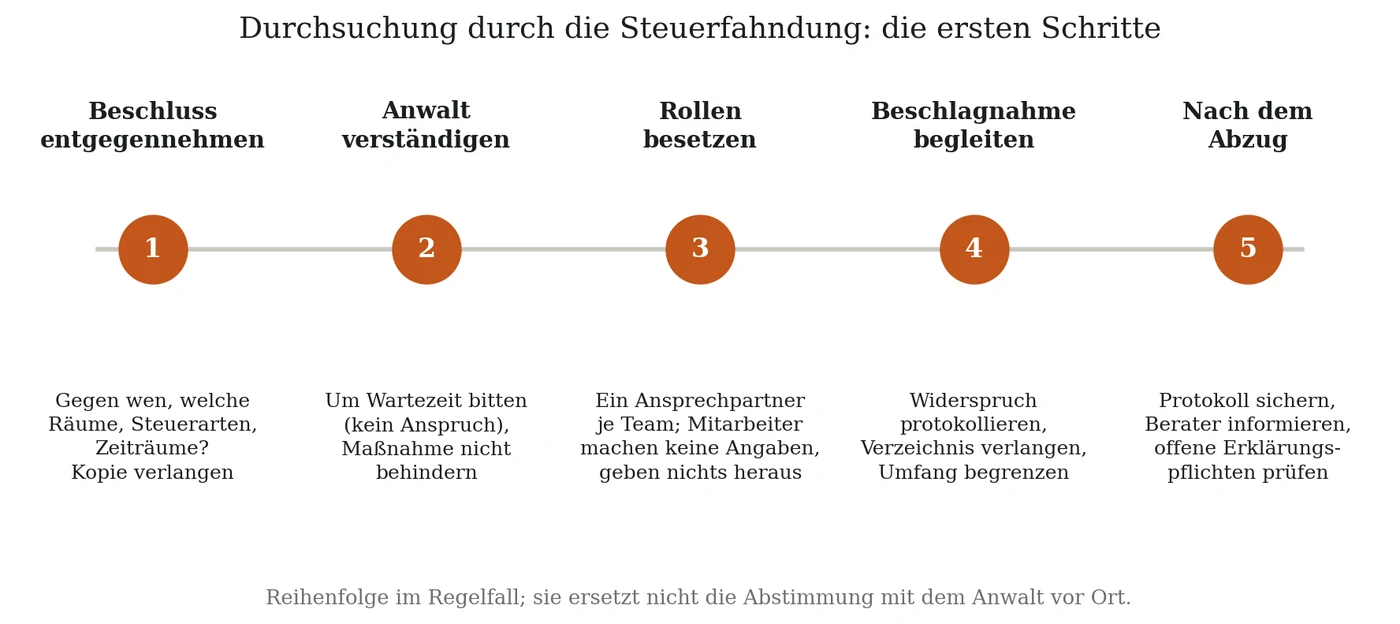
- Receive the warrant. Ask to see the officers’ ID cards and to be handed the search warrant. Insist on a copy. Read against whom it is directed, which premises, types of tax and periods it covers and when it was issued. If there is no warrant or it is older than six months, ask for the reasons for an order on the grounds of imminent danger and record them.
- Notify your lawyer. Call your lawyer and ask the officers to wait with the start of the search until the lawyer arrives. You have no right to this. A short wait is nevertheless often granted. You may not obstruct the measure: locking rooms or holding officers up can be regarded as resisting enforcement officers.
- Assign roles. For each search team, appoint a companion who goes along, listens and takes notes, but explains nothing. The other employees continue working, make no statements on the matter and hand nothing over on their own initiative. Nobody is obliged to talk on site. Witnesses only become obliged to testify through a formal examination, to which they may bring a lawyer as witness counsel.
- Accompany the seizure. Do not hand anything over voluntarily; let it be seized. Expressly object to the seizure. The objection has a legal consequence: if there is no judicial seizure order, the authority must apply for judicial confirmation within three days (Section 98 (2) StPO). Request a list of all items taken (Section 107 StPO) and make sure that what is taken remains limited to the warrant.
- After the officers leave. Secure the record, the list and the companions’ notes. Inform your tax adviser and lawyer on the same day and check with them which filing obligations continue. The search does not suspend any filing deadline.
The typical mistakes
- Talking because you have nothing to hide: A conversation about the “real background” of the bookings is a statement on the matter. It is recorded and used in the criminal proceedings. If you explain yourself on site, you commit yourself before you know the file.
- Deleting, destroying, warning: Deleting an email, destroying an invoice or calling a business partner during the search may constitute obstruction of justice for employees. For the suspect, it establishes a so-called risk of collusion, which is a ground for arrest (Section 112 (2) StPO).
- Not limiting the scope: If entire servers are mirrored or filing cabinets emptied, the authority also takes what lies outside the warrant. As a rule, you have no right to copies of the seized originals. The scope can be limited during the search, but hardly afterwards.
- Unlocking the smartphone by fingerprint: Mobile phones are frequently seized in tax criminal proceedings. You do not have to disclose an access code. The Federal Court of Justice (Bundesgerichtshof), by contrast, has held that forced unlocking by fingerprint or facial recognition is permissible (order of 13 March 2025, 2 StR 232/24, based on Section 81b StPO). If you secure your device only biometrically, you forgo the protection that the access code offers.
- Assuming adviser correspondence is protected: Correspondence with the tax adviser is only protected from seizure while it is in the adviser’s custody (Section 97 (2) StPO). The same email in your inbox can be seized. Documents that serve the defence are different: they are protected at your premises too – provided they are recognisable as such and kept separately.
The Federal Court of Justice’s decision on unlocking by fingerprint is disputed in the specialist literature. Whether the Federal Constitutional Court will take a different view is open. Until then, we recommend: access code instead of biometrics, at least for management’s devices.
What the search means for a voluntary disclosure
Once the initiation of criminal proceedings has been notified – at the latest when the officers appear to investigate a tax offence – a voluntary disclosure granting immunity from prosecution is barred for the offences concerned (Section 371 (2) sentence 1 no. 1 AO). The bar only extends as far as the proceedings, however: for other types of tax, other periods or other persons involved, a voluntary disclosure may still be possible. What matters is that whether this applies in the individual case must be checked as quickly as possible, because every further investigative step can extend the bar.
The tax proceedings continue in parallel. If documents are missing, the basis of taxation is estimated (Section 162 AO). To secure the expected back payment, the tax office can provisionally secure assets and have accounts frozen (so-called attachment order, Section 324 AO). Criminal proceedings and tax proceedings must therefore be handled together from the outset.
Five questions you can answer today
- Do reception, accounting and IT know what to do if officers with a search warrant turn up at your business at 7 o’clock tomorrow morning?
- Do you have a lawyer’s emergency number that reception and management also know?
- Has it been decided who accompanies the officers and who talks to them, even when management is absent?
- Do you know where your data is stored – on your own servers, in the cloud or with your tax adviser – and what can be seized at each of these locations?
- Is your tax filing position documented in such a way that you can show in the proceedings what was declared, when and why?
These five points are the content of a search instruction that should be in place in the business before an emergency occurs.
Dawn Raid Emergency Kit: be prepared
We prepare businesses for a search (a so-called dawn raid): with an instruction for reception, accounting and IT, an allocation of roles for management, a review of data locations and training for employees. In an emergency, we take on the defence in the tax criminal proceedings and representation in the tax proceedings from a single source. Where supplementary declarations are subsequently required, we work with a partner firm.
For the preparation, we offer you a fixed price agreed before work begins; support in an acute case is provided under a clear agreement discussed in advance. Because criminal law and tax law are under one roof with us, one team defends you in both proceedings.
Talk to us.
Frequently asked questions
Yes. With a search warrant, the officers may enter the specified premises and have them opened if necessary. You may check whether the warrant exists and what it covers, and you may call your lawyer. You may not obstruct the search itself.
No. There is no right to a postponement. In practice, a short wait is often granted. Until the lawyer arrives: read the warrant, appoint companions, make no statements on the matter, hand nothing over voluntarily.
Not for the offences that are the subject of the proceedings initiated. For other types of tax, periods or persons involved, it may still be possible. This must be checked as quickly as possible after the search.
This article provides a general overview for information purposes only and does not replace advice on individual cases. As of: November 2026.