
A managing director who discovers an error in the GmbH’s tax returns has no choice between acting and waiting: the law requires correction, and you are personally liable for the GmbH’s taxes. The only choice is the right route – a simple correction or a voluntary disclosure that grants immunity from prosecution. This choice must be made quickly and correctly.
Correction or voluntary disclosure
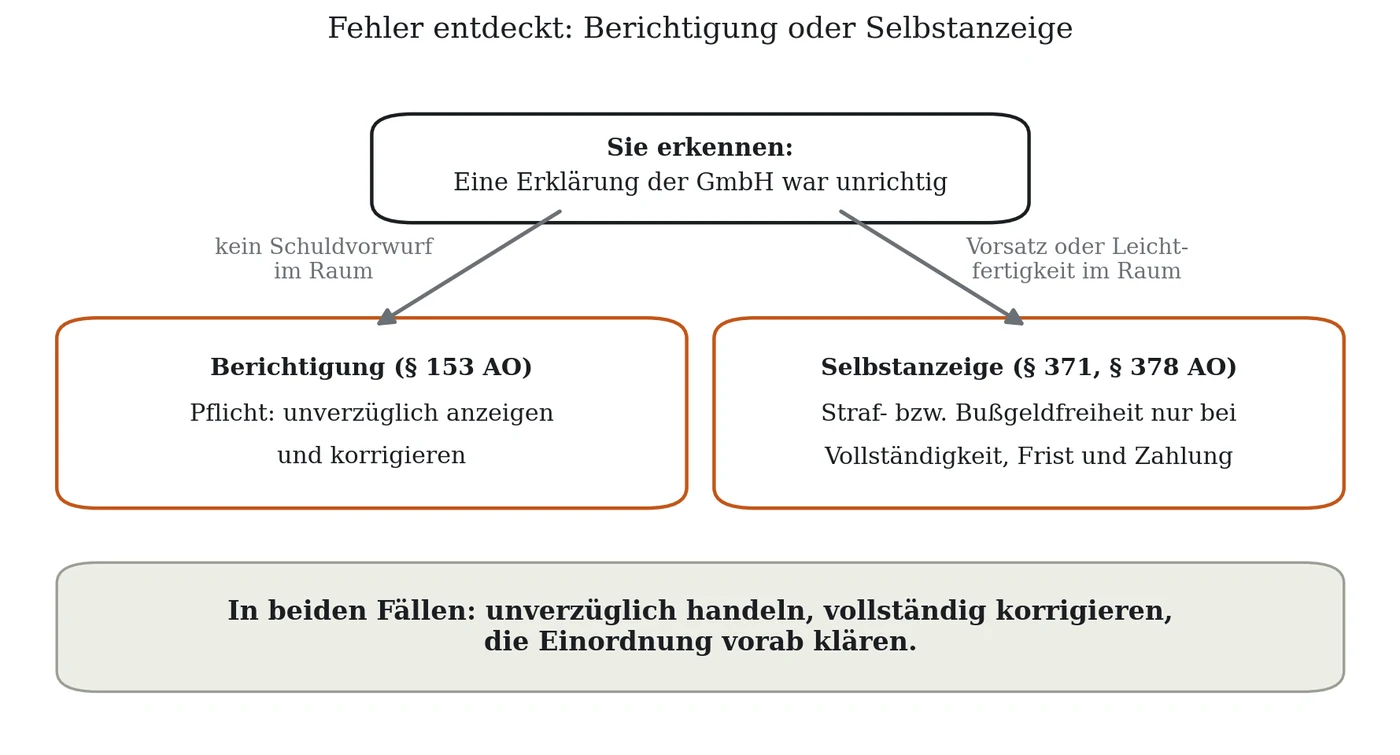
If you subsequently realise that a return submitted was incorrect or incomplete and that this may lead to an understatement of tax, you are obliged to notify and correct it without undue delay (Section 153 of the German Fiscal Code, AO). This obligation also applies to errors from your predecessor’s time as soon as you recognise them.
If the incorrect return was made with intent – or if this cannot be ruled out with certainty –, a simple correction is not enough. The route to immunity from prosecution then leads through a voluntary disclosure (Selbstanzeige, Section 371 AO): a complete supplementary declaration of all cases of a type of tax not yet time-barred, covering at least the last ten calendar years, combined with timely payment of the taxes and interest. From €25,000 per offence, a surcharge of 10 to 20 % is added.
In between lies reckless tax understatement: anyone who made incorrect statements not intentionally but with gross carelessness commits an administrative offence. There is a separate voluntary disclosure for this too (Section 378 AO). It leads to exemption from fines and is more generously available – barred only once proceedings have been notified, without the surcharge of the voluntary disclosure under criminal law. Which allegation is at issue therefore determines the route.
The line between the two routes is narrow in individual cases, and classifying the case wrongly is itself a risk: a correction labelled as such can be treated as a failed voluntary disclosure because it is incomplete. Classification therefore belongs at the start of the advice, before you contact the tax office.
Your personal liability runs alongside
Irrespective of criminal law, you as managing director are personally liable for the GmbH’s taxes that were not assessed or paid, or not on time, as a result of an intentional or grossly negligent breach of your duties (Section 69 AO) – including late-payment surcharges, and even after you leave office for the period of your responsibility. An internal allocation of duties only provides relief if it was clearly set out in writing in advance and you had no reason to doubt that your colleague was fulfilling the tasks.
The scope of the voluntary disclosure is important: it removes the penalty, not the payment obligation. The understated taxes, interest on evaded tax of 6 % per year (it is excluded from the reduction of general interest on back payments to 1.8 %) and the personal liability for them remain. Without timely payment, moreover, no immunity is granted. The liquidity for the back payment therefore belongs in the plan.
The typical mistakes
- Waiting: With every day, the risk grows that the voluntary disclosure will be barred, for example when an audit order is notified or the offence has been discovered.
- Partial correction: Half a voluntary disclosure is none. Anyone who only discloses what is likely to come to light anyway loses immunity altogether.
- Going it alone: The voluntary disclosure only takes effect for the persons who make it. With several managing directors – including former ones – coordinated action is necessary. Otherwise, the disclosure protects the person making it but at the same time incriminates others.
- The wrong instrument: Out of reluctance to use the term voluntary disclosure, a simple correction is filed where a voluntary disclosure that is complete for ten years would have been required.
- Payment not secured: Immunity requires timely payment. Anyone who discloses without making the funds available loses the protection.
In 2025, the Federal Court of Justice (Bundesgerichtshof) tightened the completeness requirements for voluntary disclosures in two decisions. Advance VAT returns and the annual return are now treated as separate offences; a voluntary disclosure must therefore also fully cover each individual advance return (1 StR 387/25). For separate determination returns, an especially serious case with a fifteen-year limitation period may exist from €140,000 of income determined too low – the period to be disclosed then extends correspondingly further back (1 StR 445/24). Voluntary disclosures already submitted should also be reviewed in this light.
Five questions for today
- Are there matters where you are unsure whether they were fully declared – such as foreign accounts, hidden profit distributions, private use of company assets or cash transactions?
- Is responsibility for tax within the management set out in writing, and is there a four-eyes principle before returns are submitted?
- Would you know what to do if the tax investigation service is at the door or criminal proceedings are initiated – and whom to call first?
- Have earlier years and your predecessor’s periods been included in your considerations, insofar as you are responsible for them today?
- Could the GmbH raise a back payment including interest at short notice – and could you personally, should liability apply?
If you hesitate on more than one question, your filing position should be reviewed – before a third party does it.
In acute cases and in prevention
We advise on such situations individually: in acute cases at short notice and in confidence, with a robust assessment before the first letter to the tax office; in prevention with a review of your filing position, responsibilities and processes.
The fact that lawyer and tax adviser come together in one person at our firm pays off precisely here: assessment, strategy and representation before the tax office and investigating authorities come from a single source. The supplementary declaration is prepared together with a specialised partner firm whose work we coordinate. For prevention, we agree fixed prices; in acute cases, we work on the basis of a clear fee agreement discussed in advance.
Talk to us.
Frequently asked questions
You must notify and correct identified errors that may lead to an understatement of tax without undue delay. There is no obligation to actively search for errors – but identified errors must not be left unaddressed.
Only if you yourself are covered by it: the voluntary disclosure takes effect for the persons who make it. Several parties involved should act in a coordinated way. And it only has an effect under criminal law – the payment obligations and the liability for them remain.
The taxes to be paid, interest on evaded tax of 6 % per year and, from €25,000 per offence, a surcharge of 10 to 20 %. In return, there is no penalty if the voluntary disclosure is complete and made on time.
This article provides a general overview for information purposes only and does not replace advice on individual cases. As of: November 2026.