
A mid-sized business files dozens of tax returns and declarations every year. That one of them will contain an error at some point is not a question of if, but of when. What happens then also depends on how the business is organised: an effective tax control system – Tax CMS for short – helps decide whether the error remains a simple correction or turns into criminal proceedings.
Why an error can turn into proceedings
Advance VAT returns, wage tax declarations, annual returns for income taxes and other types of tax – in a business, tax returns are produced practically in series, often under time pressure and passing through many hands. If you subsequently identify an error, you are obliged to notify and correct it without undue delay; if intent is at issue, the route to immunity from prosecution leads only through a voluntary disclosure. We have described this distinction in a separate article.
The real risk lies in the assessment: whether an error is regarded as a simple oversight, as recklessness or as conditional intent is judged by the tax office and investigating authorities after the event – and a business that has visibly failed to organise its tax processes may provide the basis for this allegation. Anyone who does not organise deadlines and responsibilities in a traceable way will later find it hard to be believed that the error was an oversight. For you as management, there is also the personal level: you are personally liable for the GmbH’s taxes in the event of a grossly negligent breach of duty, and organising the tax obligations is your duty as a corporate officer.
What a Tax CMS does
A Tax CMS is the documented and practised organisation of tax obligations: who is responsible for what, how data flows into the returns, who checks before submission, what happens in the event of an error. The effect of the Tax CMS comes into play at three points.
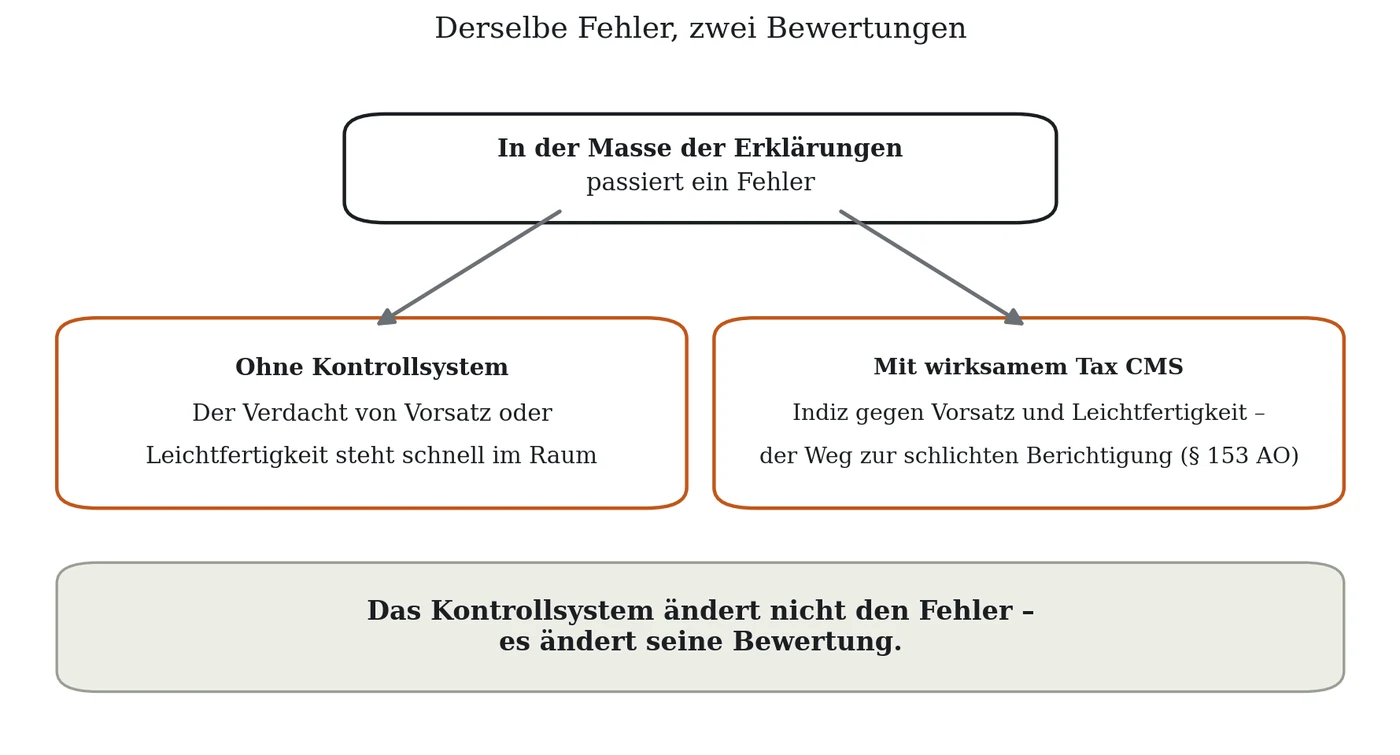
First, in tax criminal law: the tax authorities expressly recognise that an internal control system serving the fulfilment of tax obligations can be an indication against intent and recklessness (application decree on Section 153 of the German Fiscal Code, AO). The same error is assessed differently when it occurs in an organised business – the route to a simple correction without criminal treatment remains open.
Second, in the tax audit: since 2023, the tax authorities have been trialling audit relief for businesses with an effective tax control system (Article 97 Section 38 of the Introductory Act to the Fiscal Code, EGAO). If effectiveness is established in a field audit, the tax office can, on application, give a binding commitment to limit the next audit in type and scope. The trial runs until the end of 2029; anyone wishing to use the relief therefore needs the Tax CMS today.
Third, for your personal liability: anyone who sets out responsibilities in writing, monitors the performance of tasks and documents this can prove in an emergency that they have fulfilled their organisational duties – the basis of any defence against the allegation of gross negligence.
The building blocks at mid-sized scale
A Tax CMS is not a group-wide corporate project. The recognised audit standards name the elements, but the yardstick is the size of the business – as much control as necessary, as little bureaucracy as possible. For mid-sized businesses, six building blocks regularly need to be considered:
- Risk map: Which types of tax and transactions in your business harbour the greatest sources of error – such as VAT on foreign business, wage tax on benefits in kind or contracts with shareholders?
- Responsibilities: Who is responsible for which type of tax, who deputises, who approves – fixed in writing and with a clear allocation of responsibilities within management.
- Processes and deadlines: How data from accounting, payroll and contracts gets into the tax returns completely and on time – including deadline control.
- Controls: A four-eyes principle before significant returns are submitted, and spot checks on high-volume processes.
- Response plan: What happens when an error comes to light – who is informed, who classifies it and how quickly it is corrected. This is precisely where the control system and the duty to correct mesh in one process.
- Documentation and training: The system must be practised and provable; a binder in the cupboard is not a control system.
The typical mistakes
- Paper compliance: Policies are drawn up or procured but not built into actual processes. The indicative effect of the Tax CMS requires an effective, practised system – documentation without practice can even work against the business.
- Compliance without tax: Many businesses already have a general code of conduct and a whistleblowing system. This general system does not cover tax risks. They must be captured deliberately and separately.
- Standstill: New business areas, foreign sales or changed obligations such as e-invoicing alter the risk map. A system that is not kept up to date loses its protective effect.
- Delegation without monitoring: Delegating tasks to employees or an external tax adviser does not release management from its duty to select and monitor.
The trial of audit relief is under way and the tax authorities are increasingly filling it with practice: in Bavaria, the State Tax Office (Landesamt für Steuern) accepts expressions of interest for system audits in which the effectiveness of the tax control system can be established during the ongoing field audit and the relief for the subsequent audit can be bindingly committed. The commitment is subject to revocation, for example in the event of restructuring. The rule will be evaluated until 2029. For businesses with an upcoming tax audit, this is a window of opportunity that can be used deliberately with a robust system.
Five questions for today
- Could you write down today who in your business is responsible for which type of tax – and does that also apply when someone is absent?
- Is there a four-eyes principle before significant tax returns or declarations leave the business?
- Would your team know what to do if an error in a submitted return came to light tomorrow – and how quickly the correction must be made?
- Are the tax risks of your business documented comprehensively and up to date?
- Is a tax audit due in the next few years – and would your existing system be ready to demonstrate its effectiveness there?
If you hesitate on more than one question, it is worth taking a look at your tax organisation – before an error forces the answer.
Compliance Essentials for SMEs
We build compliance at mid-sized scale: risk analysis, code of conduct, the key policies, responsibilities and a practical training concept – and we embed the tax control system in it from the outset: risk map of the types of tax, processes and deadlines, controls, response plan for errors.
You receive a ready-to-use compliance package including an implementation plan. We offer you a fixed price agreed before work begins. Because law and tax are under one roof with us, the general compliance system and the Tax CMS come from a single source – not as two projects by two advisers.
Fixed price, agreed before work begins.
Frequently asked questions
The duty to organise tax processes applies to every management, regardless of size. The design should, however, match the size: in small businesses, a few pages are often enough – responsibilities, deadlines, four-eyes principle, response plan, as long as they are put into practice.
It helps in two ways: the documented system is an indication against intent and recklessness, and it proves that you have fulfilled your organisational and monitoring duties – the basis of the defence against personal liability.
If the effectiveness of the system is established in a field audit, the tax office can, on application, give a binding commitment to limit the next audit in type and scope. The trial rule runs until the end of 2029.
This article provides a general overview for information purposes only and does not replace advice on individual cases. As of: November 2026.