
A property GmbH pays no trade tax on its rental income if it exclusively manages its own real estate. Whether this so-called extended reduction (erweiterte Kürzung) is granted is decided by details: the kitchen let along with the premises, the charging point in the courtyard, the identity of the tenant and the date of the sale. This article deals with the key points to regulate.
What the extended reduction does
A GmbH and a GmbH & Co. KG with a commercial character are subject to trade tax on all their income, even if they only earn rental income. A private individual letting the same property pays no trade tax. The extended reduction is intended to offset this difference: if the company exclusively manages and uses its own real estate, the trade income from this activity is, on application, taken out of trade tax (Section 9 no. 1 sentence 2 of the German Trade Tax Act, GewStG). If it carries out another activity alongside this, there is no reduction – not even a partial one. For the property GmbH, only corporation tax plus solidarity surcharge then remains, together around 16 %.
An example: a property GmbH earns trade income of €100,000 from letting an office building. Without the reduction, at a multiplier of 490 %, around €17,000 in trade tax is incurred, plus around €16,000 in corporation tax and solidarity surcharge, together around €33,000. With the extended reduction, it remains at around €16,000. In the example, the reduction halves the company’s ongoing tax.
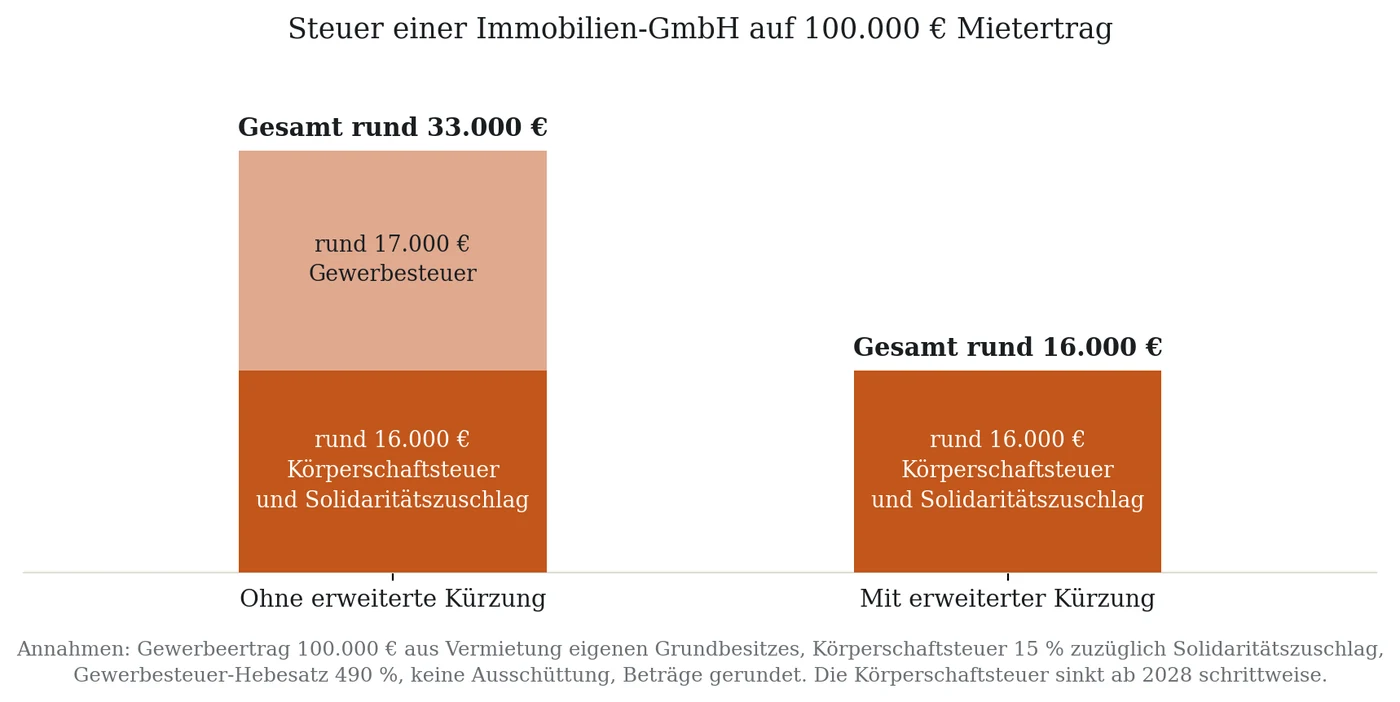
Corporation tax will fall in stages from 2028. The figures are set out in the article on the corporation tax cut. The mechanism of the reduction is not affected.
The requirement: exclusivity
The reduction requires that the company exclusively manages and uses its own real estate. In addition, it may manage its own capital assets. Exclusivity applies in three dimensions: the type of activity, its scope and time, namely for the entire assessment period, i.e. the calendar year. A harmful ancillary activity – even without income – does not cause the reduction to lapse in part, but in full for the whole year.
The legislature has created two important exceptions (Section 9 no. 1 sentence 3 GewStG). Income from supplying electricity from renewable energy and from charging stations is harmless if it amounts to no more than 20 % of the income from letting the property and the electricity is only supplied to tenants or fed into the grid. Other income from direct contractual relationships with the tenants, for example from letting operating equipment along with the premises, is harmless up to 5 % of this income. Bear in mind: income within the limits remains subject to trade tax. It merely no longer jeopardises the reduction for the rental income as a whole.
What matters in the lease
1. The leased property: the building yes, operating equipment and movable items only within limits
Operating equipment (Betriebsvorrichtungen) means installations that serve not the building but the tenant’s business: the restaurant’s kitchen fittings, high-bay racking, the production machine or the supermarket’s refrigeration system. Letting it along with the premises is not management of real estate. Until 2020, a single kitchen installation let along with the premises cost the entire reduction. Since 2021, the 5 % limit has applied. The same applies to other movable items let along with the premises that are not operating equipment, such as furniture, office equipment or the fitted kitchen of a flat: letting them is not management of real estate either, and their share of the rent also counts towards the 5 % limit.
The risk lies in measurability. A single rent for building and fittings cannot be checked for compliance with the 5 % limit. The requirement for the lease: operating equipment is either not let along with the premises – the tenant procures it themselves – or it is individually specified in the lease and given a separate arm’s-length rent. This rent must be checked against the limit every year, including when rents are increased and equipment is retrofitted.
Recent case law: The Federal Fiscal Court (Bundesfinanzhof) has ruled that letting a goods lift along with a department store and a shopping centre does not jeopardise the reduction, because the lift is part of the infrastructure that the landlord of such a building must provide (judgments of 25 September 2025, IV R 9/24 and IV R 31/23). This exception is narrow: it applies to installations without which the building cannot be used sensibly for its type, and the 5 % limit does not apply to such installations because, according to case law, letting them is part of managing the property itself. For all other operating equipment, the 5 % limit remains. Conversely, an activity without income can also be harmful: a property GmbH that held two classic cars as an investment lost the reduction (Federal Fiscal Court, judgment of 24 July 2025, III R 23/23).
2. Ancillary services
Caretaker services, cleaning of common areas, winter road clearance and the allocation of service charges are part of managing real estate. Services that go beyond management are commercial: a reception service, cleaning of the leased premises themselves, security, catering or letting with staff. The requirement for the lease: such services should not be provided by the property company; instead, the tenant engages a third party, typically a separate service company from the landlord’s sphere. If the property company does provide such services itself, the income must stay below the 5 % limit and be shown separately.
3. Electricity, photovoltaics and charging points
Since 2021, a system on the roof is no longer a reason to exclude the extended reduction. The requirement is that the electricity is supplied to the tenants or fed into the grid, not to third parties. The income must remain below 20 % of the rental income. A supply contract for solar power with a neighbouring property exceeds this permitted scope. For charging stations, by contrast, the restriction to tenants does not apply. They may also be open to third parties, as long as the 20 % limit is observed.
4. The identity of the tenant
If the real estate serves the commercial business of a shareholder of the property company, the reduction lapses completely (Section 9 no. 1 sentence 5 no. 1 GewStG). This concerns letting to the shareholder’s sole proprietorship or to a partnership in which the shareholder has an interest – according to case law, even a small one. When letting to a GmbH in which the shareholder has an interest, the split-business structure must be taken into account: if one exists, the letting is commercial and the extended reduction is excluded. Whether it arises depends on the shareholdings and the legal form of the landlord and must be reviewed on a case-by-case basis.
5. Term and sale
Exclusivity must exist for the entire assessment period. If the company sells its last property in the course of the year and thereafter only manages the purchase price, the reduction lapses for the whole year, including for the rental income up to the sale (Federal Fiscal Court, judgment of 17 October 2024, III R 1/23). The requirement for the purchase agreement: benefits and burdens only pass at the end of 31 December – according to case law, at 23:59 on the last day of the year. In the case decided, the transfer had been agreed “at the beginning of 31 December”. That was not sufficient, because on that day the company only managed capital assets. In addition, the line to commercial property dealing must be observed: if the company sells several properties within a few years, the tax office may assume property dealing (the so-called three-property limit), which excludes the extended reduction.
The debate about the reduction
The extended reduction is under political discussion. A bill from the opposition provides for its abolition from 2027 and puts the additional revenue at at least €1.5 billion a year (Bundestag printed paper 21/4745 of 17 March 2026). The Federal Ministry of Finance is also said to be examining restrictions. Nothing has been decided, and for the time being the reduction continues to apply unchanged. Even though transitional rules are to be expected, property structures should already be chosen today so that they remain viable even if the reduction is restricted in future. Where possible, the choice of a property GmbH should therefore not be based on the reduction alone.
Lease and structure: review in advance
We review the leases and corporate structure of property companies for the requirements of the extended reduction: leased property and operating equipment, ancillary services, electricity supply, identity of the tenant and the timing of acquisition and sale. Where a limit has been exceeded, we draft the agreements so that the reduction is preserved, or show whether moving to a different structure makes sense.
For the review of existing agreements, we offer you a fixed price agreed before work begins. Because law and tax are under one roof with us, one team reviews the lease and its tax consequences together.
Talk to us.
Frequently asked questions
An installation that serves the tenant’s business rather than the building: machinery, kitchen installations, refrigeration systems, high-bay racking, goods lifts in production buildings. Heating, lifts for general use and sanitary facilities, by contrast, are part of the building. The distinction must be reviewed on a case-by-case basis.
No longer automatically. Since 2021, income from letting operating equipment is harmless if it amounts to no more than 5 % of the income from letting the property. The condition is that the charge for the kitchen is shown separately in the lease or that it is provided free of charge. This applies to a restaurant kitchen as well as to the fitted kitchen of a flat: the flat’s kitchen is not operating equipment, but a movable item let along with it. With customary fitted kitchens in flats, the 5 % limit is generally not reached.
That is open. A bill from the opposition provides for its abolition from 2027, and the Ministry of Finance is examining restrictions. Nothing has been decided. Property structures should be planned so that they can cope with a restriction.
This article provides a general overview for information purposes only and does not replace advice on individual cases. As of: November 2026.