
The trade tax multiplier (Hebesatz) is 490 % in Munich and 240 % in Grünwald. Choosing a location with a low multiplier is permissible as long as the business actually operates there. The tax authorities are currently checking this vigorously, and from 2027 a higher minimum multiplier applies.
What the multiplier makes up
Trade tax is calculated in two steps. First, trade income is multiplied by 3.5 %. The result is the so-called base amount. Then the municipality in which the business has its permanent establishment applies its multiplier to the base amount. With a multiplier of 490 % (Munich), the tax is therefore 4.9 times the base amount. Each municipality sets its multiplier itself. The law only prescribes a lower limit.
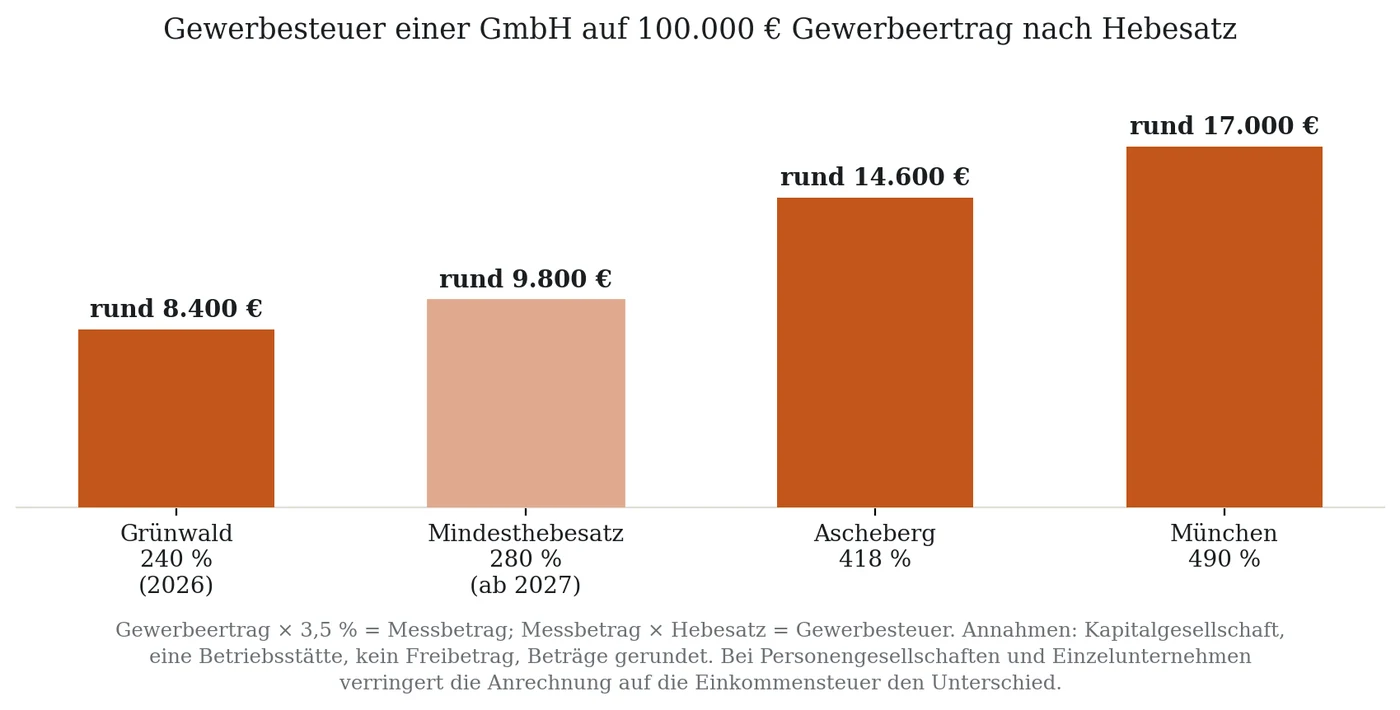
An example: a GmbH earns trade income of €100,000. The base amount is €3,500. In Munich, this results in around €17,000 in trade tax, in Grünwald around €8,400. For the GmbH, the difference of just over €8,000 is a final burden, because trade tax is neither deductible as a business expense nor creditable against any other tax at the level of the GmbH or the shareholder.
For sole proprietors and partnerships, the difference is smaller. For them, trade tax is credited against the owners’ income tax, up to four times the base amount, but no more than the trade tax actually paid (Section 35 of the German Income Tax Act, EStG). Up to a multiplier of 400 %, trade tax is thus generally neutralised. In the example, a burden of around €3,000 remains in Munich, none in Grünwald. The location advantage thus shrinks from around €8,000 to around €3,000.
From 2027, the statutory minimum multiplier rises from 200 % to 280 % (Section 16 (4) sentence 2 of the German Trade Tax Act, GewStG, as amended by the Ninth Act amending the Tax Advisers Act). Municipalities such as Grünwald must raise their multiplier. In the example, the tax there rises from around €8,400 to at least around €9,800. The gap to Munich remains significant but narrows.
Where the tax arises
Trade tax is due to the municipality in which the business maintains a permanent establishment, i.e. a fixed place of business that serves the business (Section 12 of the German Fiscal Code, AO). The place of management is deemed to be a permanent establishment. It is where the day-to-day business decisions are actually taken (Section 10 AO). The registered office entered in the commercial register and the postal address are not decisive for this.
Two consequences follow. First: a letterbox, a business-centre address or a rented room that is not used does not establish a permanent establishment in the low-tax municipality if business is actually conducted from elsewhere – for example from the office or home office in Munich. Trade tax is then due to the municipality where the work is actually done. Second: if the business has permanent establishments in several municipalities, the base amount is split between them (so-called apportionment, Sections 28 et seq. GewStG). The yardstick is the wages paid at the individual establishments, with no more than €50,000 counting per employee. A small management office in Grünwald and ten employees in Munich therefore mean that by far the largest part of the tax flows to Munich.
The legal line runs along the information given to the tax office. If a business declares a permanent establishment in Grünwald in its trade tax return although it is actually managed in Munich, these are incorrect statements about facts relevant for tax purposes. The tax authorities are currently pursuing such cases in a targeted way: in North Rhine-Westphalia, a central unit of the Düsseldorf public prosecutor’s office, together with the State Office for Combating Financial Crime, searched offices in Monheim am Rhein and other municipalities in spring 2026. At the centre was a provider that had rented out office addresses to more than a hundred businesses. In Bavaria, the Munich I Regional Court convicted individuals back in 2023 of, among other things, trade tax evasion because a registered office declared in Grünwald was actually in Munich. Conversely: if the business is actually managed at the declared location, the low multiplier is unobjectionable.
What shows a permissible choice of location
A location with a low multiplier is unobjectionable if the business actually has its place of management or its permanent establishment there. This can be checked with five questions:
- Are there premises of your own at the location that the business has at its disposal – with a lease, equipment and actual use – and not just an address?
- Does management work from there regularly, and can this be proven – for example through calendars, meetings, correspondence and resolutions?
- Are employees working at the location?
- Do the details in the trade tax return match the actual circumstances, and, where there are several permanent establishments, are they all declared?
- In the case of a relocation, has the move actually been completed – premises at the old location given up, management and workplaces moved, business partners informed?
If these questions can be answered with yes, the low multiplier is a permissible location advantage. If the answer is no, the situation should be reviewed and the return corrected if necessary (Section 153 AO).
Location and permanent establishment: review in advance
We check whether your business’s place of management and permanent establishments are where they are declared. If a relocation is planned, we support its implementation so that it is recognised for tax purposes. If it turns out that previous returns are not correct, we clarify with you whether a correction or a voluntary disclosure is the right route. The supplementary declaration itself is handled by a specialised partner firm.
For the location review, we offer you a fixed price agreed before work begins. Because law and tax are under one roof with us, one team reviews the corporate law question of the registered office and the permanent establishment for tax purposes together.
Talk to us.
Frequently asked questions
Yes. The choice of location is permissible if the business is actually managed there or has a genuine permanent establishment there. An address without premises, staff and decisions on site is not enough.
As a rule, no. What matters is where the day-to-day decisions are taken and where the work is done. A room that is merely rented but not used does not establish a permanent establishment.
Trade tax is due to the municipality where management actually takes place. If a different municipality was declared intentionally, tax evasion may be at issue. Multipliers: as of 2026.
This article provides a general overview for information purposes only and does not replace advice on individual cases. As of: November 2026.