
When a GmbH slides into over-indebtedness, the shareholder’s subordination of a loan (Rangrücktritt) is one of the standard tools for averting an insolvency filing. The insolvency law requirements for the subordination clause are strict. Anyone who fulfils them too strictly, however, triggers a taxable gain in the middle of the crisis without any inflow of cash. Three words in the clause decide this.
What it is about
If a shareholder has lent money to their GmbH and the company runs into a crisis, there are three basic tools to choose from: leaving the loan in place, declaring a subordination or waiving repayment. Each tool has its own legal and tax requirements, which do not always run in parallel: what rescues the company under insolvency law can become expensive in tax terms. The subordination is the focus here because it is the one most often needed in practice – and the one most often worded incorrectly.
Tool 1: Leaving the loan in place
Legally, a shareholder loan is subordinated in insolvency anyway (Section 39 (1) no. 5 of the German Insolvency Code, InsO). The insolvency administrator can reclaim a repayment made in the year before the insolvency filing (Section 135 InsO). Leaving the loan in place does not help against over-indebtedness, however: in the over-indebtedness balance sheet, the loan still counts as a liability. For tax purposes, leaving it in place is unproblematic as long as the interest is at arm’s length – excessive interest paid to the shareholder, by contrast, is a hidden profit distribution.
For the shareholder’s later tax position, documentation already counts at this stage: if a loan is deliberately left in place during a crisis, its later default can have a positive effect as subsequent acquisition costs of the shareholding (Section 17 (2a) of the German Income Tax Act, EStG). This decision should therefore be recorded in writing.
Tool 2: Subordination
A subordination takes the loan out of the over-indebtedness balance sheet (Section 19 (2) sentence 2 InsO) and thereby removes the ground for insolvency. For this to work, a so-called qualified subordination is required: the claim ranks behind the claims of all other creditors. The payment block applies even before insolvency, as long as and to the extent that a payment would cause or deepen over-indebtedness or illiquidity. It also covers interest and ancillary claims, and it is not time-limited (Federal Court of Justice, Bundesgerichtshof, judgment of 5 March 2015, IX ZR 133/14). A payment made in breach of the subordination has no legal basis and must be repaid – a liability risk for you as management.
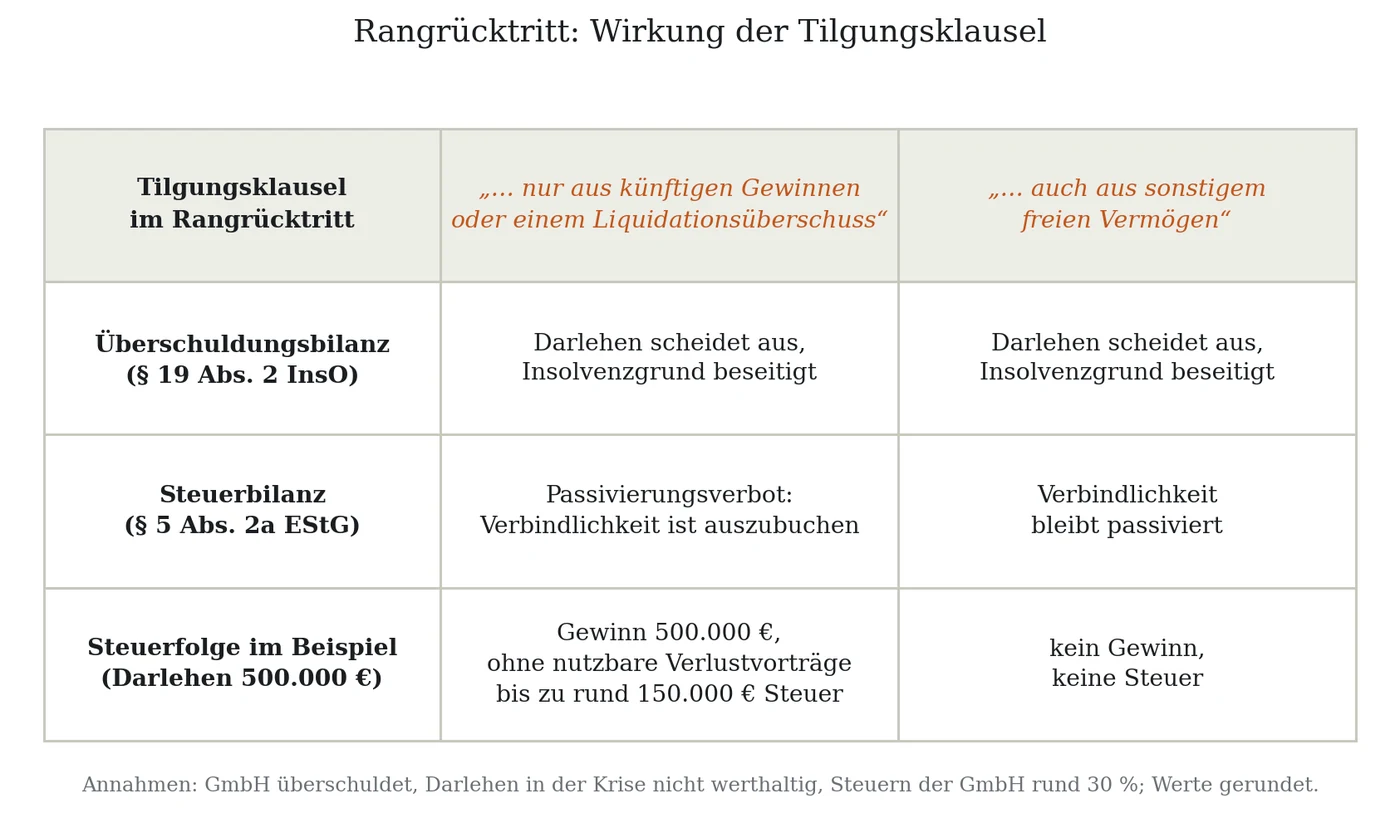
For tax purposes, a different sentence of the clause is decisive: the source of repayment. If it states that the loan may only be repaid from future profits or a liquidation surplus, the prohibition on recognising liabilities under Section 5 (2a) EStG applies. The liability must be derecognised from the tax balance sheet, and its elimination is a taxable gain. This gain is only neutralised as a shareholder contribution to the extent that the loan still had value – in a crisis, it generally does not (Federal Fiscal Court, Bundesfinanzhof, judgment of 15 April 2015, I R 44/14). As a result, the GmbH pays tax on the elimination of a debt it could never pay – precisely when it has no money.
The way out lies in three words: if the clause provides that the loan may also be repaid from other free assets, the liability remains in the tax balance sheet (Federal Fiscal Court, judgment of 19 August 2020, XI R 32/18). The over-indebtedness is removed all the same, because the payment block under insolvency law is unaffected. Both requirements – the strict block for insolvency law, the broad source of repayment for tax law – must therefore be set out in the same clause.
An example: a shareholder loan of €500,000, the GmbH is over-indebted, the loan no longer has value in the crisis. If the clause provides for repayment only from future profits, a gain of €500,000 arises – without usable loss carryforwards, this triggers up to around €150,000 in tax. If it provides for repayment also from other free assets, there is no gain and no tax.
Tool 3: Waiver
A waiver of the claim is the strongest remedy against over-indebtedness, because the liability ceases to exist for good. Its elimination also gives rise to a gain which – as with the subordination – is treated as a contribution only to the extent of the part that still has value. The remainder without value is in principle taxable. However, the tax exemption for restructuring gains may apply (Section 3a EStG). This requires proof that the business is in need of restructuring and capable of being restructured, that the waiver is suitable for restructuring and that the creditor acts with the intention of restructuring. In addition, existing loss carryforwards are used up first.
The GmbH cannot rely on this exemption in the case of an incorrectly worded subordination: according to the wording of the law, it requires a debt to be forgiven, whereas the subordination leaves the claim in existence. Whether the gain from derecognition can nevertheless qualify for relief has not been settled by the highest court. A correctly worded subordination avoids the question, because no gain arises in the first place.
The typical mistakes
- The template clause from the internet: Many templates are usable under insolvency law but dangerous for tax purposes because they restrict repayment to future profits. They remove the over-indebtedness – and trigger the gain.
- The time-limited subordination: A subordination “until 31 December” does not remove the over-indebtedness; the claim remains in the over-indebtedness balance sheet, and the insolvency filing is still required.
- The interest: Anyone who declares the subordination only for the loan amount and continues to service the interest pays in breach of the block – and leaves the protection of the clause.
- The waiver for convenience: Anyone who “simply writes off” the loan to tidy up the balance sheet creates the taxable gain that a correctly worded subordination would have avoided. The proof required for the tax exemption for restructuring gains often cannot be provided after the event.
- Missing documentation: Without written proof that the loan was deliberately left in place during the crisis, the shareholder often loses the deduction as subsequent acquisition costs on a later default.
The position of shareholders on the default of a loan has improved. If the loan defaults without counting as subsequent acquisition costs of the shareholding, the loss could only be offset against other investment income up to €20,000 per year until 2024. The legislature abolished this limit with the Annual Tax Act 2024 retroactively for all open cases. Anyone who was only able to claim a loan default in part in recent years should have it checked whether the assessments can still be amended.
For practice, this means: which tool fits is decided by the GmbH’s situation, the existence of loss carryforwards and your own tax situation as shareholder. The clause itself is then not a formality but the place where insolvency law and tax law must come together in one sentence – and it must be reviewed before it is signed.
Shareholder loans and crisis: review in advance
We review existing loan and subordination agreements for their effect under insolvency law and their tax consequences, and draft a clause that holds up on both counts; in an acute crisis, we advise on the choice between subordination (where appropriate with a debtor warrant, Besserungsschein) and waiver, including the consequences for you as shareholder.
For the review of existing agreements and the drafting of the subordination, we offer you a fixed price agreed before work begins; support during the crisis is provided under a clear agreement discussed in advance. Because law and tax are under one roof with us, one team reviews both sides of the same clause.
Talk to us.
Frequently asked questions
An agreement by which the shareholder ranks their loan behind all other creditors – without time limit, including interest and with a payment block that applies even before insolvency. Only a subordination designed in this way takes the loan out of the over-indebtedness balance sheet.
Only if worded incorrectly: if the loan may be repaid exclusively from future profits or a liquidation surplus, the GmbH must derecognise it from the tax balance sheet and pay tax on its elimination. If the clause also permits repayment from other free assets, the liability remains and no gain arises.
A correctly worded subordination removes over-indebtedness without tax consequences and preserves the claim. A waiver creates a taxable gain to the extent that the loan no longer has value. It is mainly an option where the requirements of the tax exemption for restructuring gains are met.
This article provides a general overview for information purposes only and does not replace advice on individual cases. As of: November 2026.