
In a company acquisition, there is no single better structure: the same choice between an asset deal and a share deal works out in opposite ways for buyer and seller, both legally and for tax purposes. The structure is therefore not a formality but a negotiating point with a price of its own.
What the choice is about
In a share deal, the buyer acquires the shares in the company — in the case of a GmbH, the Geschäftsanteile. The business thus changes hands as a whole. Contracts, liabilities and risks remain unchanged within the company; only the ownership of the company changes. In an asset deal, the buyer acquires individual assets and contractual relationships out of the company: machinery, inventory, customer contracts, intellectual property rights. The seller is then not the shareholder but the company itself.
It is important to note that both routes can lead to the same economic result and yet differ considerably in legal and tax terms. The overview shows the differences on the five points that regularly tip the balance in negotiations:
| Criterion | Share deal | Asset deal |
|---|---|---|
| Object of purchase and completion | The shares as a whole; for a GmbH, notarisation is required. | Each asset and each contract is transferred individually. Formal requirements apply, for example, to real estate. |
| Contracts and employment relationships | Continue unchanged within the company; the exception is contracts with change-of-control clauses. | Counterparties must consent to the transfer; employment relationships pass over by operation of law (Section 613a of the German Civil Code, BGB). |
| Liability for the past | The buyer takes over the company with its entire history; protection via warranties and indemnities. | Certain risks stay behind; the buyer is nevertheless liable under individual statutory provisions, for example for operating taxes. |
| Tax for the seller | Favourable for direct holdings: 40 % of the gain is tax-free; via a holding company around 1.5 % at holding level. | The company pays full tax on the capital gain; passing the proceeds on to the shareholder additionally costs withholding tax on investment income. |
| Tax for the buyer | No tax-reducing depreciation on the acquired shares. | Acquired assets and goodwill can be depreciated. |
In practice, it is often the last two tax points that decide the structure: the seller’s tax and the buyer’s depreciation.
Commercially decisive: the seller’s tax
The tax difference arises from the number of taxation levels. In a share deal, the gain is taxed once, at your level as shareholder. In an asset deal, the GmbH first pays tax on the gain from selling its assets. If the proceeds are to reach you privately, they must additionally be distributed and are subject to withholding tax on investment income.
An example with a capital gain of €1 million: in an asset deal, the GmbH first pays around 30 % corporation tax and trade tax. Distributing the remainder costs a further 26 % or so. Only just under €520,000 reaches you; the overall burden comes close to 50 %. In a share deal from private assets, 60 % of the gain is taxed at your personal tax rate (the so-called partial income method, Teileinkünfteverfahren): at the top tax rate, this results in a tax burden of around €280,000. If a holding company sells and the gain is not distributed, the tax stays at around €15,000. If the holding later distributes the proceeds to you, withholding tax is added; the overall burden of around €275,000 is then close to that of a sale from private assets. How this structure works and what applies to the private use of the proceeds is described in a separate article.
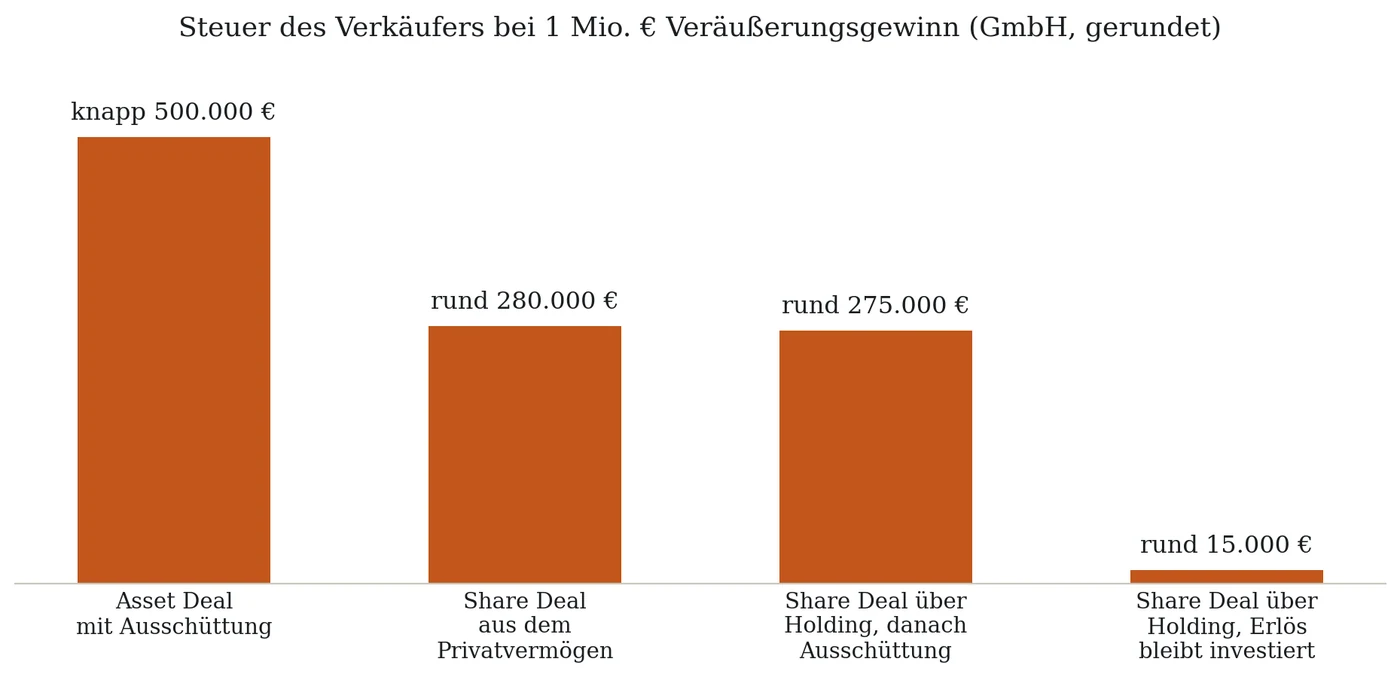
These figures apply to the GmbH. For partnerships and sole proprietorships, separate and in part more favourable rules apply to an asset deal, such as a tax-free allowance and a reduced tax rate from the age of 55. We will be happy to advise you on this.
The buyer’s tax – the signs reversed
For the buyer, the picture is reversed: in an asset deal, the buyer allocates the purchase price to the acquired assets and depreciates them. Any amount above that is amortised as goodwill over 15 years. The purchase price paid thus reduces the tax burden of the ongoing business over the following years. In a share deal, the shares themselves cannot be depreciated. As a rule, the purchase price only reduces tax on a later resale. In addition, current tax losses and loss carryforwards of the target company are generally forfeited when more than 50 % of the shares are acquired.
What decides the choice
- Who is selling: Do you hold the shares as a private individual, or are they held by your holding company or a partnership? This determines how large the tax gap between the structures turns out to be.
- State of the history: The harder it is to examine the company’s past, the more likely the buyer is to push for an asset deal.
- The buyer’s financing: A buyer who wants to refinance the purchase price through depreciation will pay less in a share deal or demand a discount.
- Tied contracts: If key customer, lease or licence agreements depend on consents or change-of-control clauses, this often decides how the transfer works in practice.
- Real estate: Land regularly triggers real estate transfer tax in both structures — immediately in an asset deal, and in a share deal from a transfer of 90 % of the shares. Planning the completion thus becomes a review point in its own right.
Always keep in mind: the opposing interests in an asset deal and a share deal do not disappear — they are priced in. A seller who pushes through a share deal often pays for the buyer’s missing depreciation through the purchase price. Conversely, a buyer who pushes through an asset deal compensates for the seller’s higher tax within the purchase price. That is why the question of structure belongs, well informed, at the start of the negotiation.
For share deals involving companies that own real estate, a long-standing dispute has been resolved by statute since July 2026: where signing and completion fell apart in time, real estate transfer tax could previously be assessed for both events. Under the new law, as a rule only signing is taxed (Section 1 (3b) of the German Real Estate Transfer Tax Act, GrEStG); at the same time, the notification period was extended to one month. For past cases with a double assessment, the Federal Fiscal Court (Bundesfinanzhof) grants interim relief (order of 9 July 2025, II B 13/25); we will support you with the correction.
Vendor Due Diligence Light
Asset deal or share deal: what the buyer finds in due diligence determines structure, warranties and price. We review your business before the sale process through the eyes of a buyer: contracts, compliance, tax issues, change-of-control risks.
You receive findings reports on the points that would bother a buyer, with concrete recommendations for clean-up before the process. We offer you a fixed price agreed before work begins. Because law and tax are under one roof with us, one team reviews both sides.
Fixed price, agreed before work begins.
Frequently asked questions
In a share deal, the shares in the company are sold. The business changes owner as a whole. In an asset deal, the company sells individual assets and contracts; each item must be transferred individually.
A share deal is taxed favourably for the seller. An asset deal gives the buyer depreciation volume and the choice of which risks to take over. The balance is struck through the purchase price.
Yes. The liabilities remain in the company and pass over economically. They must be taken into account when determining the purchase price.
This article provides a general overview for information purposes only and does not replace advice on individual cases. As of: November 2026.