
In a company sale, the purchase price is rarely a single figure. It consists of a fixed part, adjustments and often a variable component, the so-called earn-out. Earn-out clauses allocate risk between buyer and seller and help determine when you as the seller pay tax on the purchase price.
What it is about
We have already written about the structure of the sale — asset deal or share deal. This article deals with the next level of negotiation: the clauses that set, adjust and secure the purchase price itself. Two variants are most common in sales of mid-sized businesses. The earn-out is not a third variant but a second tier: a variable component that can be added to either.
Variant 1: Fixed price with an effective date in the past
The purchase price is fixed on the basis of the last annual financial statements and is not adjusted after completion (the so-called locked box). In return, you as the seller guarantee that nothing unusual flows out of the business between the effective date and completion (so-called leakage).
The risk lies in the demarcation: ongoing salaries and customary payments must remain permitted, a special distribution to the seller must not. The requirement for the purchase agreement is therefore an exhaustive list of permitted outflows. In addition, it must be determined whether and how interest accrues on the purchase price from the agreed effective date. For sellers, this variant is the most predictable — the price is fixed, and the potential for disputes after completion is limited.
Variant 2: Price adjustment based on closing accounts
As an alternative to the locked-box concept, a provisional price is agreed and adjusted after completion on the basis of a balance sheet as at the completion date. Typically, the adjustments relate to cash, net financial debt and net working capital (the so-called closing accounts concept). The buyer thus pays for the state of the business on the day of handover.
The risk: after completion, the buyer prepares the relevant balance sheet, and every unclear definition then becomes room for manoeuvre for the buyer. The same therefore applies to the clause as to any basis of assessment: the calculation method must be fixed without any discretion. This includes clear definitions of the items included, continuation of the previous accounting methods, a sample calculation as an annex to the agreement and a neutral expert for disputes.
The second tier: the earn-out
The earn-out is a variable part of the purchase price that depends on the future performance of the business, for example on revenue or earnings over the next one to three years. An earn-out can exist independently of the basic purchase price mechanism. It bridges differing price expectations: the buyer pays the full price only if the business develops as the seller has held out.
The basic risk for you as the seller: after completion, the buyer runs the business — and can thus influence the metric on which the rest of your purchase price depends, for example through shifted costs, group charges or restructuring of the business. Four basic drafting requirements follow from this:
- Metric: As tamper-proof as possible. Revenue is more robust than an earnings figure that can be influenced by costs and charges.
- Term: As short as is commercially justifiable. The longer the period, the greater the buyer’s influence on the result. The length of the earn-out period must suit the business.
- Protective clauses: Continuation of the business in the ordinary course of business, no structural interference with the reference figure, information and inspection rights for you.
- Procedure: Clear calculation with documentation duties, due-date rules, a maximum and where appropriate a minimum amount, and a neutral expert for disputes over the calculation. Imprecision invites disputes and costs money.
Tax helps shape the clause
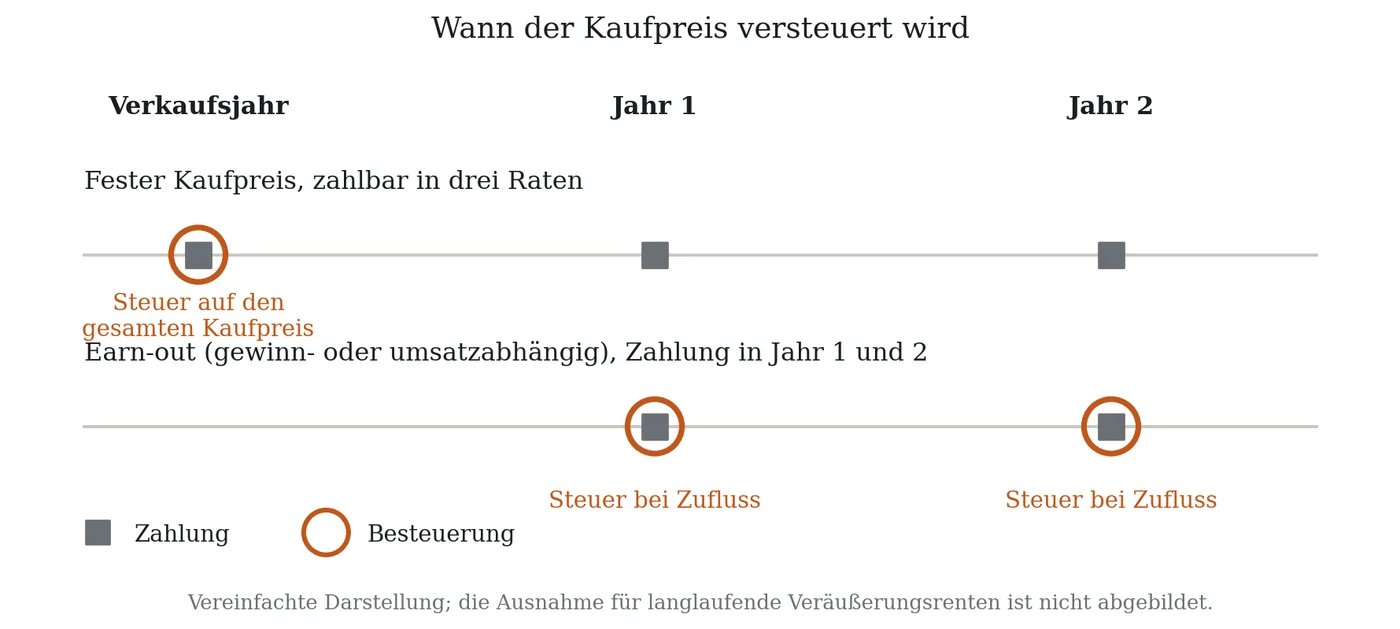
The timing of taxation depends on how the clause is drafted. The principle: a firmly agreed purchase price is taxed in the year of sale — even if it is paid later in instalments. Tax can therefore become due before all the money has arrived. Only in narrow exceptional cases, such as long-running sale annuities, is there a choice.
The earn-out is different: under case law, you generally pay tax on profit- or revenue-dependent components of the purchase price whose amount is not fixed in advance only in the year in which they are received, most recently confirmed by the Federal Fiscal Court (Bundesfinanzhof, judgment of 9 November 2023, IV R 9/21). This protects liquidity and spreads the tax burden over the years.
Taxation on receipt has a downside if you sell a sole proprietorship or a partnership interest. The earn-out payments themselves are excluded from the tax-free allowance and the reduced tax rate. Whether these reliefs are at least preserved for the fixed portion in the year of sale has not been settled by the highest court: part of the specialist literature considers them at risk because, with an earn-out, the purchase price is no longer received in a lump sum in one year. For the tax-free allowance, the earn-out also counts towards the value thresholds. Anyone relying on these reliefs should therefore have an earn-out reviewed for tax purposes before agreeing it.
If you sell GmbH shares from private assets, the partial income method continues to apply to the later payments as well. If a holding company sells, the extensive exemption, as described in the holding article, also applies to the later payments. The reliefs for the sale of sole proprietorships and partnership interests do not apply here anyway.
For your negotiation, this means: clause and tax consequence belong in the same round of negotiation. What appears in the term sheet as a mere payment schedule also fixes the timing of taxation. You should therefore have the purchase price structure reviewed for tax purposes before you sign the term sheet.
Vendor Due Diligence Light
We review your business before the sale process through the eyes of a buyer, and the planned purchase price structure for its legal and tax consequences: building blocks, metrics, protective clauses, timing of taxation.
You receive findings reports on the points that would bother a buyer, and an assessment of which purchase price components suit your situation, at the speed you need. We offer you a fixed price agreed before work begins. We then support the negotiation of the purchase agreement as a separate mandate, likewise preferably at a fixed price per phase. Because law and tax are under one roof with us, one team reviews both sides.
Fixed price, agreed before work begins.
Frequently asked questions
A variable part of the purchase price that depends on the future performance of the business, for example on revenue or earnings over the next one to three years. It bridges differing price expectations of buyer and seller.
As a rule, you pay tax on profit- or revenue-dependent payments only in the year in which they are received. A firmly agreed purchase price, by contrast, is taxed in the year of sale, even if it is paid in instalments.
With a tamper-proof metric, a short term, clauses on the continuation of the business, information rights and a defined procedure for disputes over the calculation.
This article provides a general overview for information purposes only and does not replace advice on individual cases. As of: November 2026.