
Anyone who moves away from Germany holding at least 1 % in a corporation must pay tax on the hidden reserves of the shares as if they had been sold – except that nobody sells and no money flows to the person leaving. Since 2022, this has also applied with greater severity to moves within the EU. Anyone planning to move abroad must plan the tax beforehand; afterwards it is often too late.
How exit tax arises
The mechanism works as follows: on moving away, Germany’s right to tax a later capital gain ends. The law therefore deems a sale at market value to take place at the moment of departure (Section 6 of the German Foreign Tax Act, AStG). You are affected if you have held at least 1 % in a corporation in the last five years and were subject to unlimited tax liability (i.e., in principle, resident in Germany) for at least seven of the last twelve years.
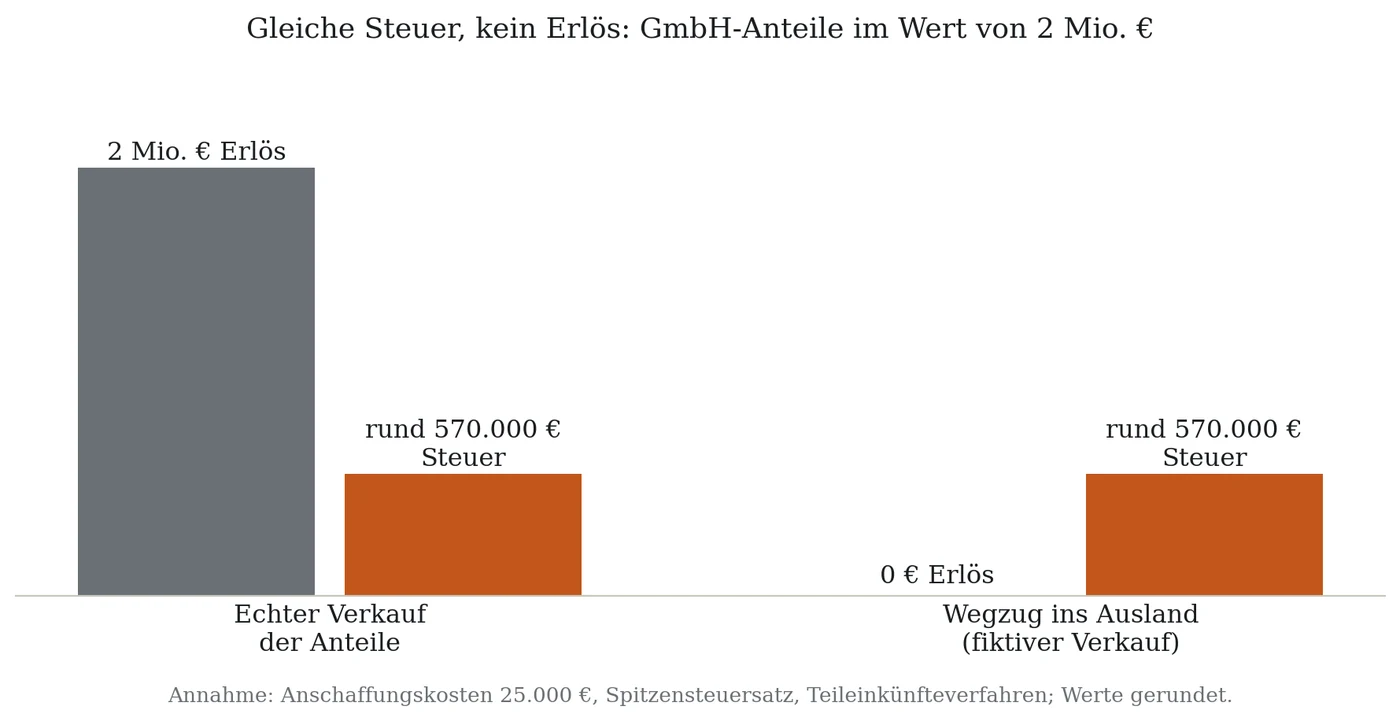
An example: you hold GmbH shares worth €2 million; you founded the company a few years ago with a share capital of €25,000. At the top tax rate, moving away triggers around €570,000 in tax – as much as a real sale from private assets, only without proceeds. Shares in a holding company are also covered: the structure that helps on a sale does not help on moving abroad. What is often overlooked is that moving away is not the only trigger – a gift or inheritance of the shares to a person living abroad leads to the same tax consequences.
What has applied since 2022
Until the end of 2021, the tax on a move to an EU or EEA state was deferred permanently and interest-free. Since 2022, it has in principle been due immediately. The only remaining option is to spread the tax payment, on application, over seven equal annual instalments. This is interest-free, but as a rule only against the provision of security. In terms of the overall burden, a move to Austria is thus treated in principle in the same way as a move to Dubai.
One important relief remains: the return rule. If you return to Germany within seven years – extendable to up to twelve years under certain conditions – the tax lapses retroactively and tax already paid is refunded. You do not have to prove an intention to return when you leave (Federal Fiscal Court, Bundesfinanzhof, judgment of 21 December 2022, I R 55/19). During the time abroad, however, the shares must not be sold. Significant profit distributions during this period can jeopardise the entitlement.
The typical sources of error
- The underestimated value: Without a sale, there is no market price. The tax office then generally values the shares using a standardised method that multiplies the annual earnings by a factor of 13.75 – the calculated value is often far above the figure the shareholders have in mind.
- The gift to children abroad: The classic case, triggered without the parents moving at all – for example when shares are gifted and transferred to a child who permanently lives and works abroad.
- Liquidity: The tax arises without proceeds, plus possible security for the instalment payments – both tie up assets that are often invested in or needed by the business.
- Reporting obligations: Instalment payments and the return rule are tied to annual notifications. Anyone who misses them risks the entire remaining amount falling due immediately.
- The short-stay misconception: A temporary assignment abroad or retirement in the south can also meet the requirements. The return rule catches this, but only if deadlines and other obligations are handled properly.
Two things are in motion. First, since 2025, exit tax has also covered large fund holdings – from 1 % of the fund or €500,000 in acquisition costs. Second, following the case law of the Federal Fiscal Court, the tax authorities have recognised permanent interest-free deferral for past cases – a move to Switzerland before 2022 (Federal Ministry of Finance circular of 2 June 2025 following the judgment of 6 September 2023, I R 35/20). Whether permanent deferral can also be enforced for moves since 2022 has not yet been settled by the courts; the specialist literature considers it well arguable. Those affected should therefore not let assessments become final and should apply for deferral. We will be happy to advise you.
How the move can be planned
Those who plan in good time have tools: before moving, shares can be transferred into structures that are not subject to exit tax, such as a GmbH & Co. KG with a commercial character and a domestic permanent establishment; family foundations and gifts subject to a reserved usufruct are also part of the toolbox. Each of these instruments has its own advantages and disadvantages and must be reviewed on a case-by-case basis – and always before the move, because once the border is crossed, the tax has arisen.
Five questions for today
- Do you or family members hold at least 1 % in a corporation – and is a move, study abroad or retirement abroad conceivable in the family?
- Do you know the value of your shares under the tax office’s standardised valuation method – not just your own estimate?
- Could you finance the tax on this value today without selling shares?
- Are gifts or the succession planned so that a recipient living abroad does not unintentionally trigger the tax?
- If a move has already taken place: are the assessments still open, has deferral been applied for and are the annual reporting obligations being met?
If you hesitate on more than one question, the situation should be reviewed before the next key decision.
Before the move and afterwards
We advise on exit tax cases individually: before the move with a valuation of the shares, a review of the structuring options and a clear roadmap; after the move with deferral applications, challenges to open assessments and reliable handling of ongoing obligations.
Because law and tax are under one roof with us, structuring and tax implementation come from a single source. For exit planning, we agree fixed prices; ongoing support is provided under a clear agreement discussed in advance.
Talk to us.
Frequently asked questions
Yes. Since 2022, a move to Austria or Spain has in principle been treated in the same way as a move to a third country: the tax is assessed and is in principle due; on application, seven interest-free annual instalments are possible, but as a rule only against security.
If you return within seven years – extendable to up to twelve years – the tax lapses retroactively and tax paid is refunded. You do not have to prove an intention to return when you leave. Sales and significant distributions during the time abroad can jeopardise the entitlement.
Yes. A gift or inheritance of the shares to a person resident abroad also triggers the tax. Succession planning and exit tax should therefore be considered together.
This article provides a general overview for information purposes only and does not replace advice on individual cases. As of: November 2026.